


Last month, Link in Bio conducted a survey to get a pulse check on the social media industry. We received 834 responses from social media professionals across industries—ranging from those working on big and small accounts alike. Today we’re sharing part one of the results. Plus, for the first time, we are able compare the data from this year’s survey against last year’s to really understand how the numbers are trending. It’s a fascinating and honest look into the work we all do.
The survey was created, run, and analyzed with Mitch Goldstein. All graphics were designed by Bryan Fountain. Paid subscribers can join us in the Link in Bio Discord today to ask us specific questions about the data!
Platform playbook
In this section we’ll dive into all of the insights around the platforms we post on.
59% of social marketers would choose Instagram if they could only post on one platform for the rest of the year.
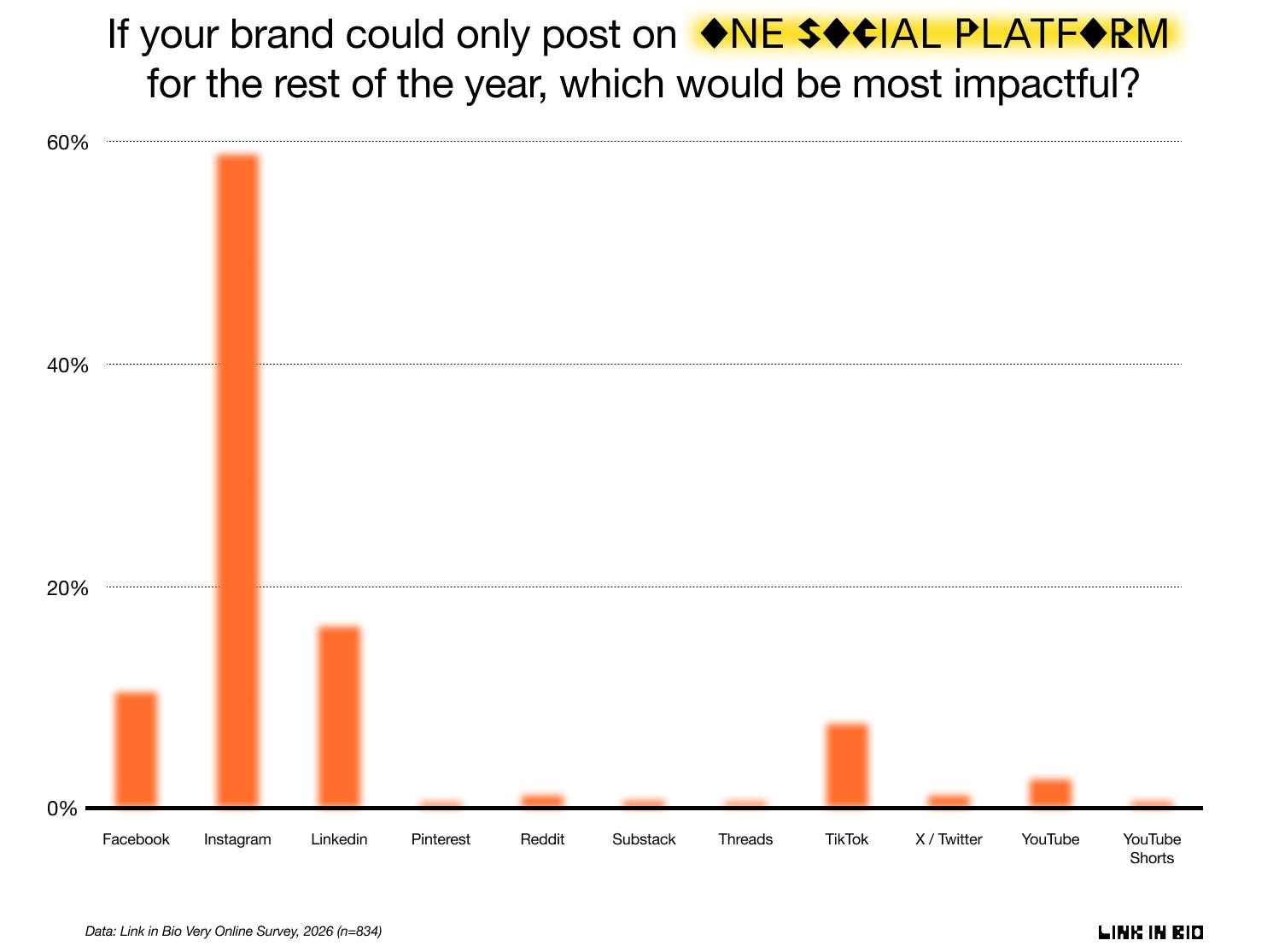
Perhaps because change is scary or maybe because the biggest platforms continue to dominate so much of our attention, this is one of the data points that stayed closest to last year’s results. Instagram has the largest majority of responses, with LinkedIn coming in second at 15% and Facebook at 10%. This newsletter has covered before that Facebook continues to be a “sleeper” hit for many brands.
27% of social marketers say that TikTok is the hardest platform to crack.
While that is slightly down from last year’s survey (33%), perhaps more interesting is that a significantly higher percentage of respondents noted that they are having trouble figuring out how to break through on YouTube. Last year, 9% of respondents said that YouTube was the hardest to crack, whereas this year that metric rose to 15%. As you’ll see below, YouTube also rose YoY as a platform respondents consider a “priority”.
Reddit, YouTube Shorts, and Substack rose YoY as platforms social marketers would consider a “priority”.
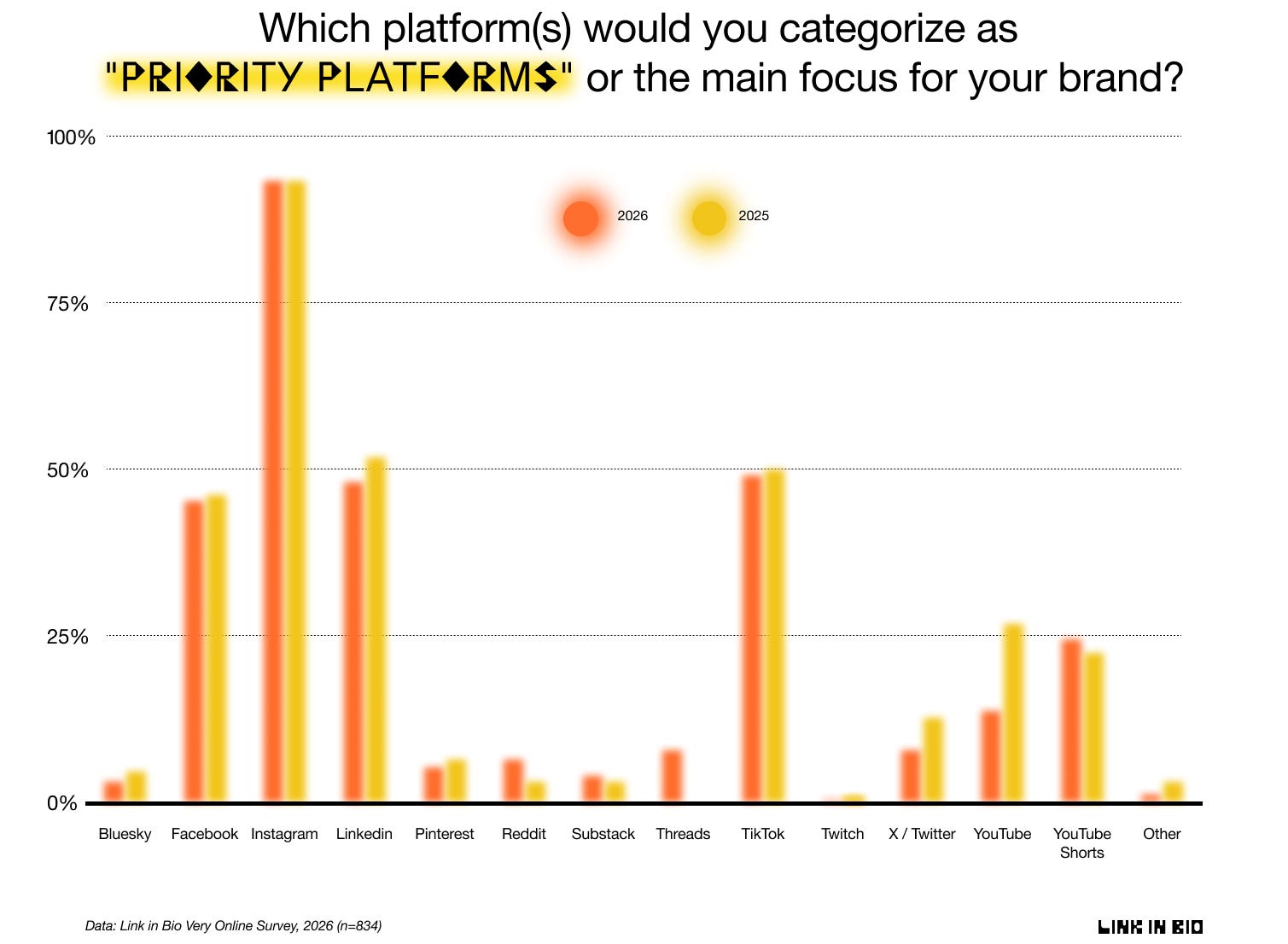
Like last year, almost 92% of all respondents said that Instagram is a “priority platform” for them. More interesting were the platforms that we saw the largest increases in compared to last year: YouTube Shorts rose 11% since last year’s survey, and while only 8% of social media marketers consider Reddit a priority platform, it’s almost doubled compared to 2025. Substack also grew from 4% to 5% YoY.
We have heard from some marketers that they are being asked to focus on Reddit to try and help increase their brands presence on LLMs like ChatGPT and Claude, with the understanding that many of the "recommendations" those tools give are scraped from Reddit. The rise in YouTube Shorts further solidifies short-form video as a multi-platform format. As many brands continue investing in vertical video, YouTube Shorts is capturing more and more attention alongside standard YouTube formats, and many brands are realizing that the content they’re creating for Reels and TikTok can likely be doing additional work on Shorts as well (much like Senator Warnock’s team’s work on the platform, covered here from earlier this year!) Finally, we’ve seen brands launch on Substack in recent months, like Notes by MERIT and Signals: A Publication by ShopMy.
We didn’t track Threads last year so we can’t compare, but we’d venture to guess that would have also increased…
26% of social marketers have launched a new account in the last six months. Of those that launched a new account, the most popular platform was TikTok.
Many noted they were “late”. Right behind was YouTube, YouTube Shorts, and Reddit. It’s likely worth noting that it wasn’t so long ago that there seemed to be a real chance TikTok might actually get banned in the United States. Now that the company’s US arm has been split off, it is possible that more brands decided it was a safer bet to invest resources in.
56% of social marketers said they are moving away from certain platforms. Of those that responded yes, the most common answer was X/Twitter with 32%.
The migration away from the platform formally known as Twitter continues. Those who reported actively leaving the platform mentioned issues around brand safety, moderation, and their audience no longer being active on the platform.
Post performance
In this section we’ll take a look at the post formats and strategies that are driving results.
Like last year, carousels slightly edged out short-form videos as the type of post performing best for your brand right now.
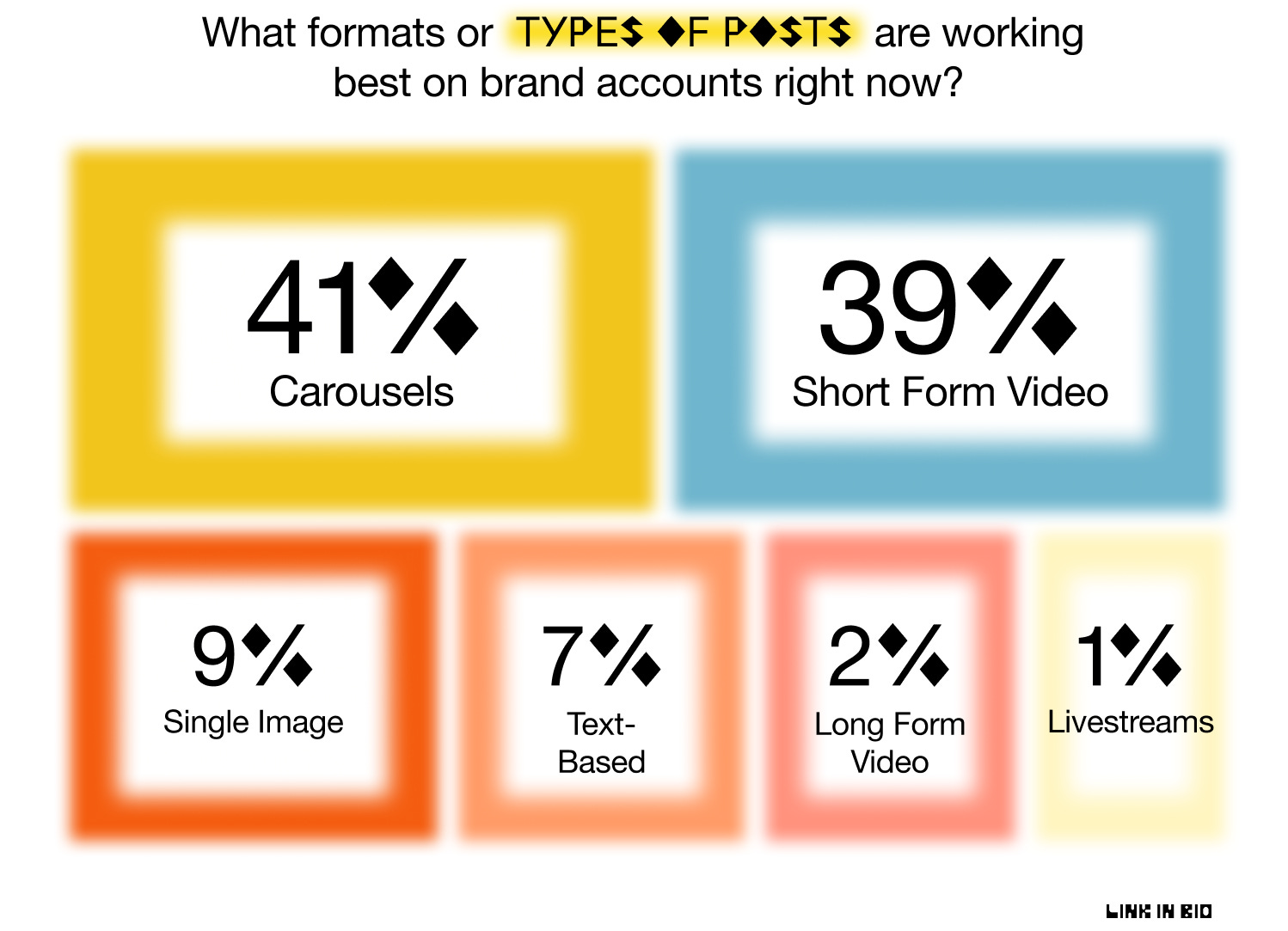
When I spoke with the Instagram team last year, they shared that the two post formats that are most effective for reaching new audiences are Reels and carousels. While I think short-form video is important for growth in today’s algorithm, carousels are the post format with the most visibility opportunities. They show up in the Reels tab if they feature music and also receive multiple ranking chances—slides within your post that your followers didn’t swipe to are sometimes treated as new content and resurfaced on the feed. Another notable stat is that in 2025’s survey, 13% of you said single-image posts were performing best. That number is down to 9% this year.
When I asked “Beyond format, how would you describe the posts that are performing well right now?” there were a few themes that popped up. Behind-the-scenes content that highlights the people and process behind the work. Educational content wrapped up in entertaining ways. Content that is either overtly anti-AI or proves that AI wasn’t used. Serialized concepts and worldbuilding. Tapping into niche subcultures and fandoms. Goofy, humorous memes. One person even shared that they hired a comedy writer to do a workshop with their team which I thought was a genius idea!
Brands are leaning into a “my show is on” mentality.
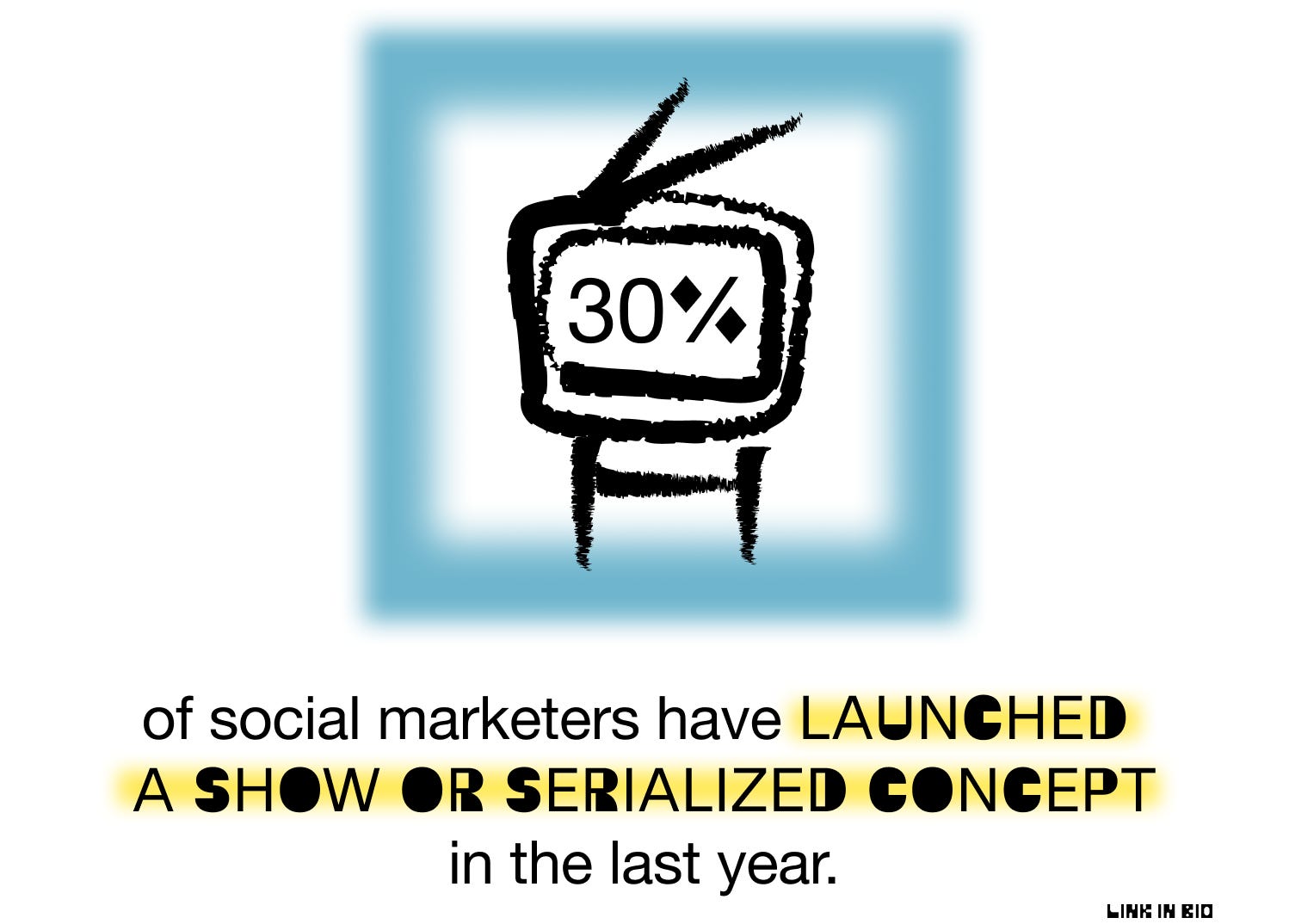
When asked how the new series is performing, the reviews were mixed. We heard everything from “extremely well” to “middling with brief signs of potential” to “not well”. Many said that it started off strong but then steadily declined. They weren’t able to keep up the momentum. One person said, “First one was great, rest were meh.”
But for those who did see success, they saw a lot of success. I heard anecdotes like “40k followers in 6 months”, “one ep went viral and got us 25K+ followers”, and “90k followers in the span of 2 weeks.” Some of the accounts that have had success mentioned turning an overperforming video into a series. Basically treating a one-off viral video like a pilot and continuing to do the same thing until it’s a “series”.
These are 18 brands with “great social”.
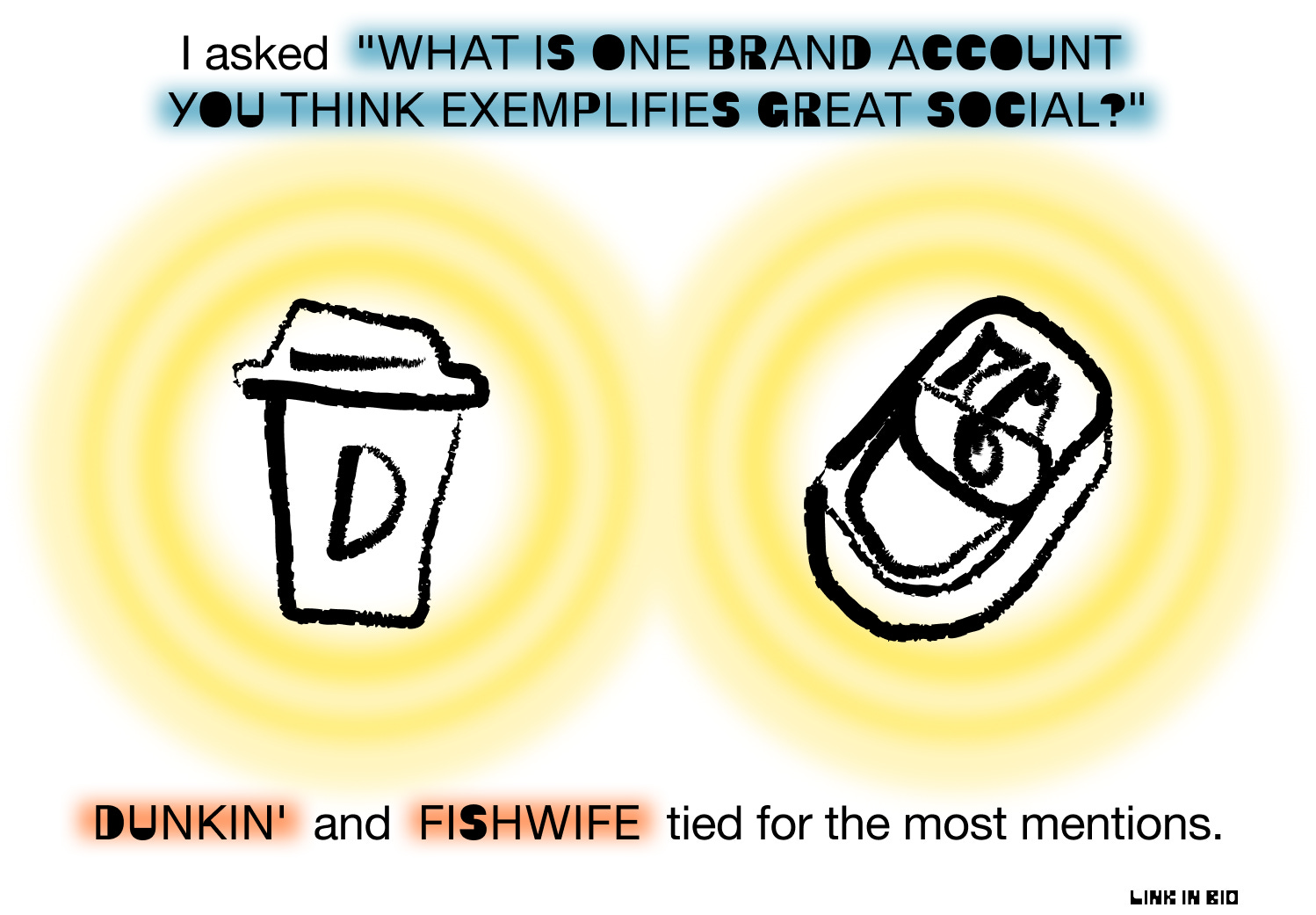
The top mentioned brands were Fishwife, Dunkin, Ffern, Merit, Loewe, PBS, NYC Mayor, National Park Service, Slate, BEÍS, Los Angeles Public Library, Columbus Library, More Perfect Union, Chili’s, Figma, Calm, Brita, and HubSpot. You can see all 438 accounts mentioned here.
We’re starting to lose interest in chasing trends…
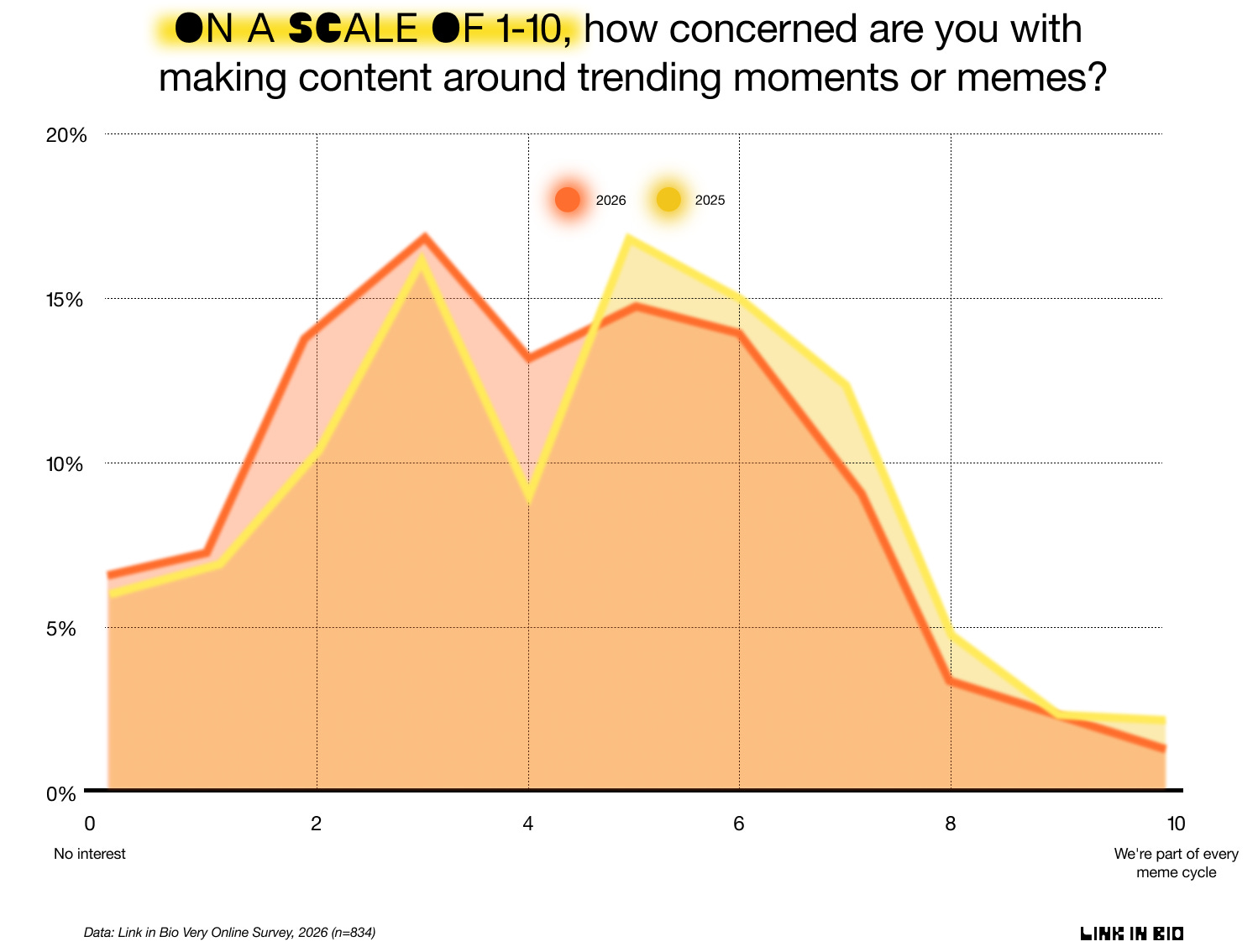
19% more respondents were on the “less interested” (responded with a 4 or lower) side of the chart in chasing trends YoY. Anecdotally, it does feel like there are fewer and fewer TikTok audio trends than 2-3 years ago. At the same time, we’re seeing that some of the most successful brands are creating original content that not only performs well but feels more memorable.
When I interviewed Merit’s CMO Aila Morin earlier this year, she shared, “We used to try participating in TikTok trends. My theory though is that why would you even want that to be the content that goes viral? Because it’s probably not the best representation of your brand. And is that what you want people to remember? Not only are we not fast enough for it—nor are we very good at it, to be honest—it’s never really driven anything for us that’s been of value.”
Time, resources, and budget are holding you back from making the content you know would perform.
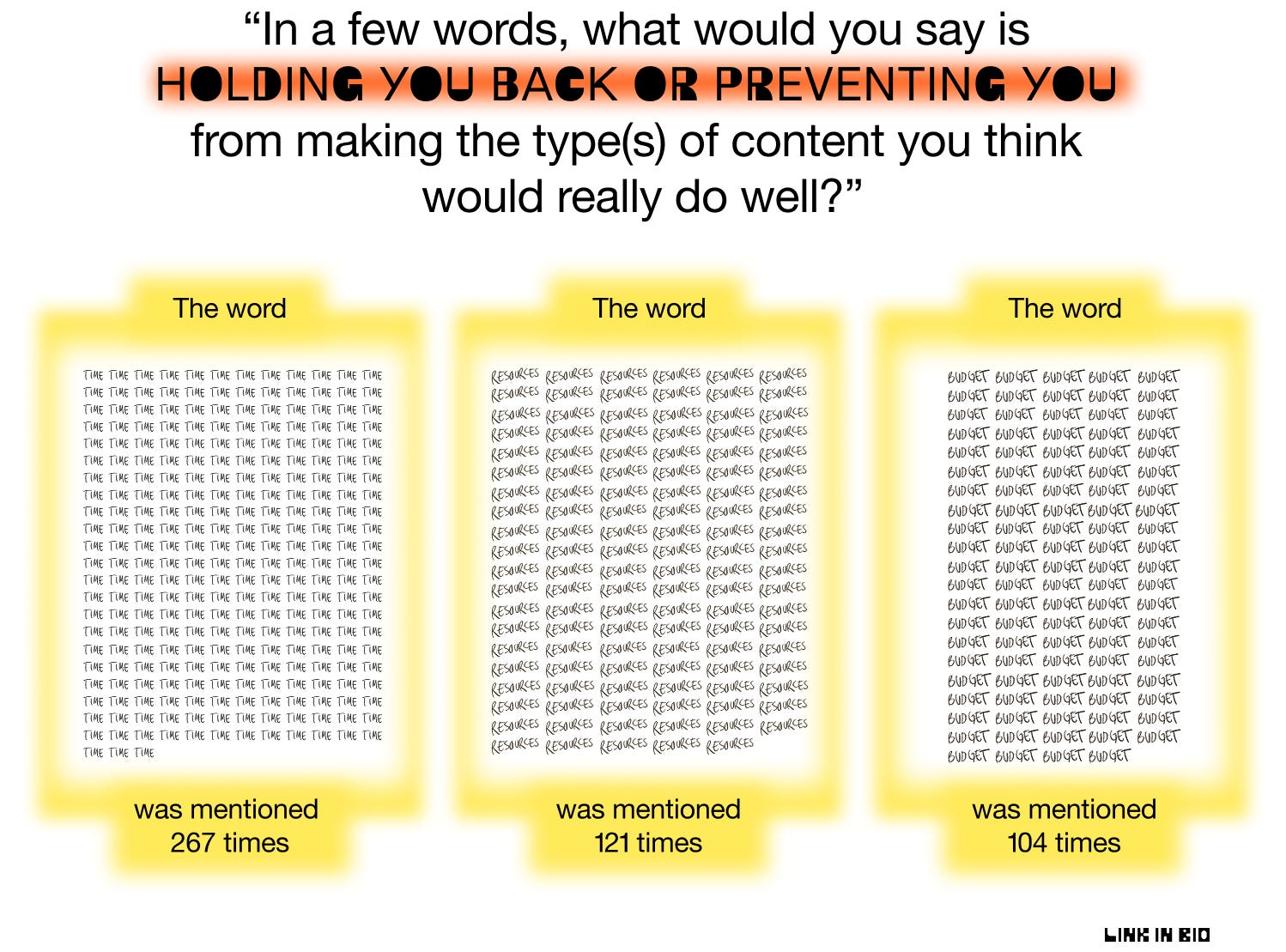
It’s clear the biggest theme was having the time and bandwidth to make what works. Someone wrote in, “More of my job is *talking about making stuff* rather than *actually making stuff*”. Another person shared, “I just wish we could stop the treadmill for a second to focus on the ‘why’ behind our posts, not just the ‘when’.” Another theme that came up quite a bit was having people willing to be on camera. “Would LOVE to make a serialized content series but we don’t have a ‘video ready’ staff to throw on camera.” A lot of social marketers know that a human face is helpful to grab attention, but are having trouble finding people who want to be that face. Other themes include budget, approval processes, and video skillset.
19% of respondents said they primarily focus on B2B content in their work. 56% of them said they’d choose LinkedIn if they could only post on one platform for the rest of the year.
Here are a few other stats we pulled out about those who work in B2B: 20% of B2B respondents said Instagram is the hardest platform to crack. 73% reported that carousels were the best performing post format. Almost 45% of respondents working on B2B operate as social teams of one. B2B brands like Ramp, HubSpot, and Slate were called out as having “great” social media.
Vibe Check
In this section we’ll cover how social media marketers are feeling right now.
44% of social marketers feel like their boss doesn’t understand social media.
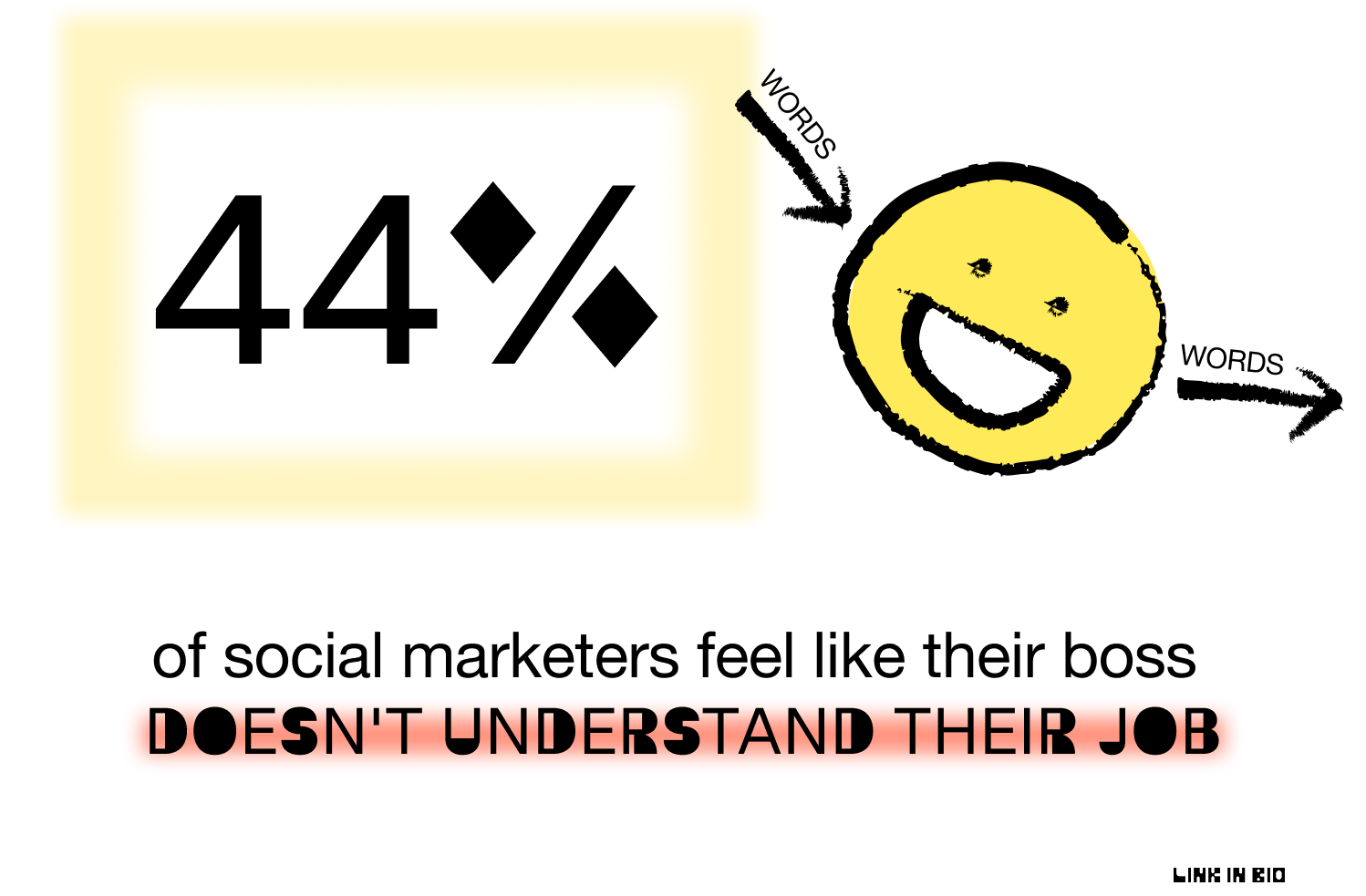
While we heard plenty of stories of supportive teams and bosses who help talent grow and mature, we unfortunately also heard a fair amount of cases where social media teams are still being treated as secondary or afterthoughts to larger marketing initiatives. From either just not “getting it” or understaffing and underresourcing, we heard things like:
“My job would be easier if leadership had some understanding of social media.”
“Approvals have to go through our CMO who only cares about aesthetic and not content that actually works to grow accounts.”
“If leadership doesn’t understand social, but still insists on imprinting on it, you’re doomed.”
59% of social marketers feel like things are better than last year.
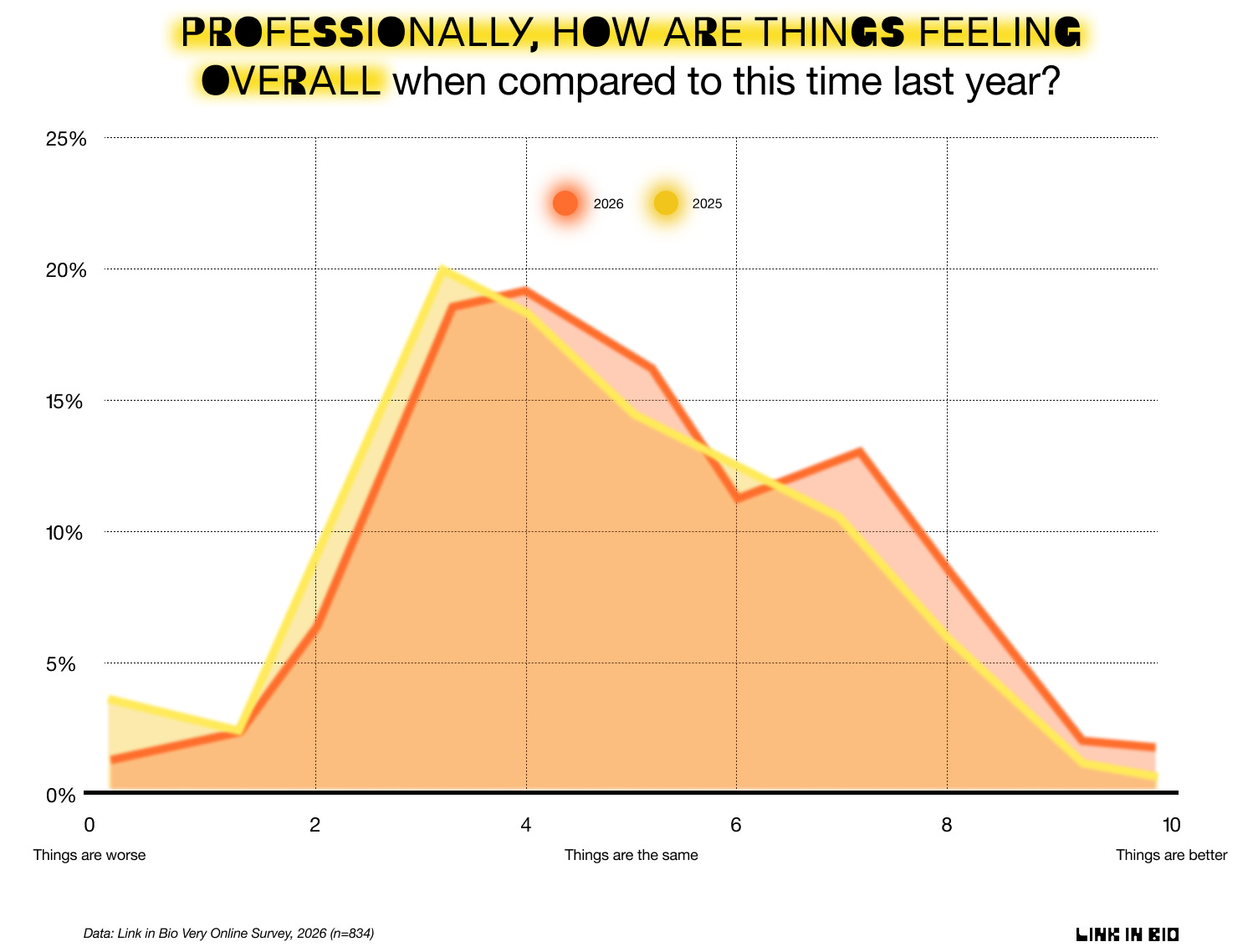
In the big picture, overall when we asked on a scale of 1 (Things are worse) to 10 (Things are better) how you feel compared to last year, more social marketers ranked things at an 8 or above. In fact, 62% more people responded with an 8 or higher compared to last year. Our jobs are wild, sometimes stressful, and often chaotic, but they can also be fun, inspiring, and creative.
We did also notice that respondents who said their boss “understands” social media also happened to skew higher on ranking that things overall felt better than last year.
We still need to touch grass.
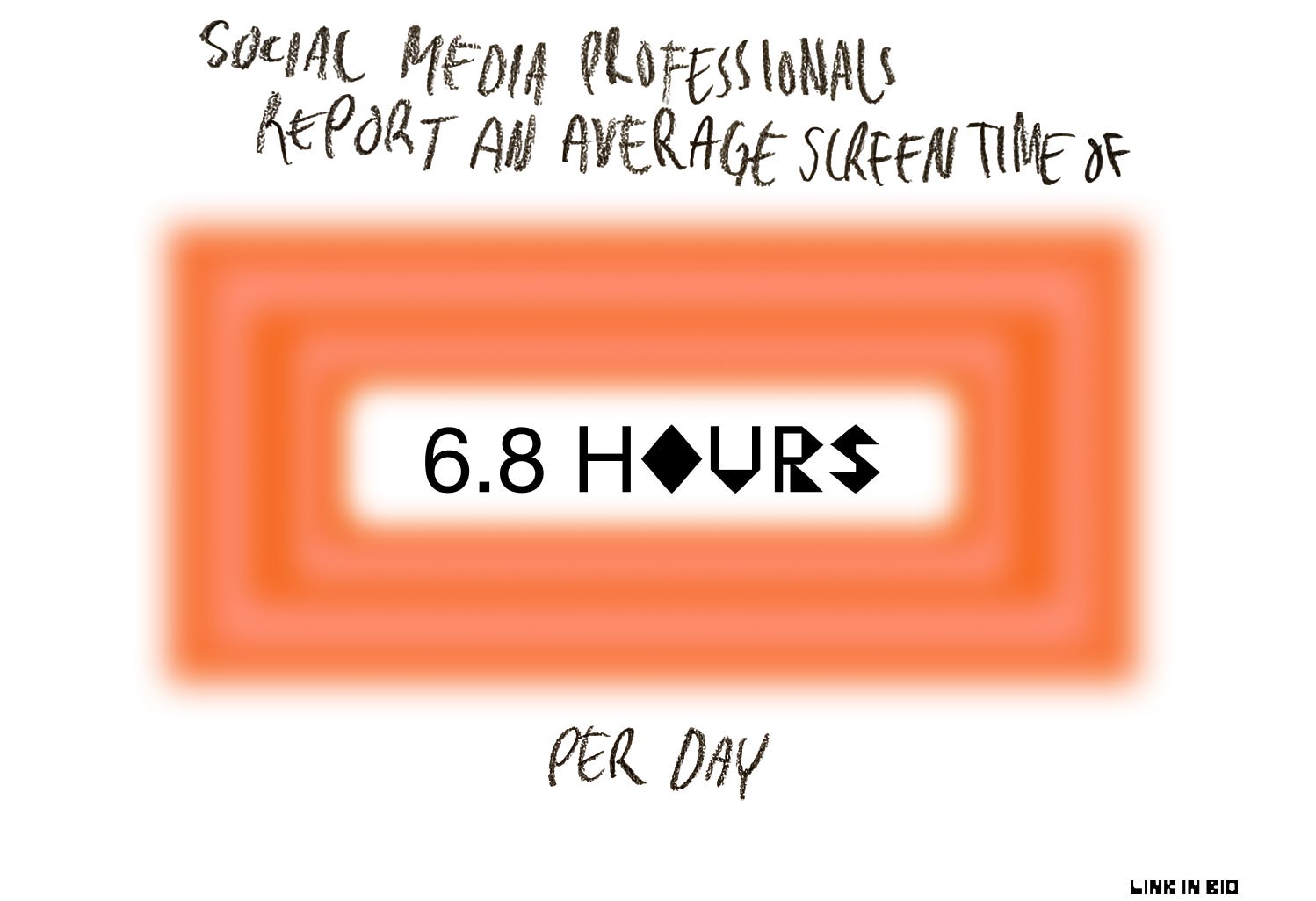
This is technically down from last year’s average of 7.3 hours, but still. In a profession where we are constantly “professionally logged on”, something we continue to hear from our peers is a want to be able to step away, and why so many of us still swear by devices or apps to lock us out of apps that draw so much of our attention. One person wrote, “I have been so tempted to get one of those Bricks. I’m so close to doing it.”
We are exhausted, overwhelmed, and tired.
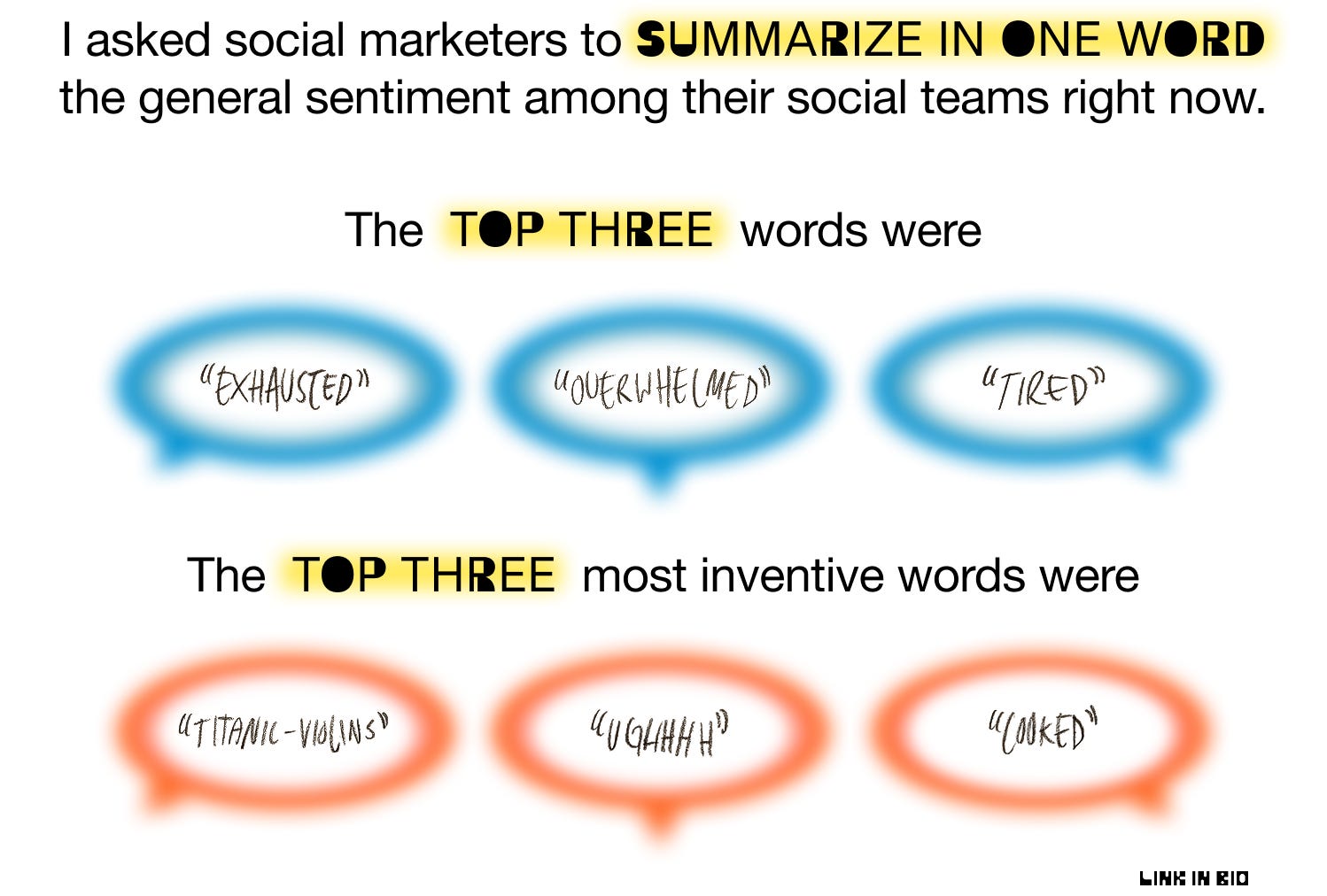
Those are the same top three most frequent words from last year. In fact, the words “overwhelmed”, “exhausted”, and “tired” made up 24% of the total answers. Even those who said things were better than last year summarized their overall moods with terms of sheer exhaustion and despair. Some other choice words included “titanic-violins”, “UGHHHHH”, and “cooked”. Not everything was negative though! We also heard “Optimistic”, “Challenged”, and “hungry”.
Final thoughts
As I read through the written answers, there were a lot of ethical concerns about working in social media. Yes, the day-to-day work is challenging but what are the long-term moral implications? One person said, “This job continues to require more and more cognitive dissonance. Not sure how long it will be worth it. But I do it for my team, whom I love.” Another said, “Does my being here, earning a paycheck from this, make me complicit in the societal ills social media contributes to?” One respondent recommended finding a therapist who is at least somewhat online because “it will save a lot of time explaining social media dynamics mid-session”.
With that, also comes questions around if people will even be on social media much longer. One person shared, “I do think that offline is coming sooner than we think. I think social is quickly sinking into ad-infested casino, and user appetites are waning!” Another person said, “I think, as social media managers, we have to recognize that our numbers aren’t going to continue growing forever. The day of social as we know it may be coming to an end. So we have to consider: how do we build community beyond the feed? What does social media look like beyond just these channels?”
I know it’s easy to read through this and feel defeated. I also try to look for the bright spots. 59% of social marketers feel like things are better than last year! As one person noted at the end of their survey responses, “Political issues behind the platforms and AI-generated content make me want to stop working in social media. But brands doubling down on brilliant, episodic content and putting out AI statements gives me hope and weirdly, when the content is good, I love my job more than ever. That tension has been draining.” I agree. It’s a hard, fun, exhausting, exhilarating, demanding, weird, silly, rewarding job. I’m grateful to get to figure it out with all of you.
This is just the first send of many using the data from this survey. More soon on the best advice you’ve ever received, how AI is impacting your role, and the tools that make you better at your job. Until then, if you have any questions about the results we’ve shared so far, please don’t hesitate to reach out and ask!
This is such excellent, thorough work. I love how open your respondents are with you, and the illustrations and design make this fun to keep reading until the end. THANK YOU FOR YOUR WORK.
Great summary. As a strategist leading international marketing, I’ve personally moved everything onto our own server - our website is the centre of gravity. Social media only drive traffic there, and we’re building the whole ecosystem in‑house. I’m not counting on social platforms anymore; I can feel in my bones that something is going to shift, and you’ll want to actually own your content and your traffic.