


Good morning!
Back in November, one of my favorite creators launched a marketing agency. You probably know Anthony Po, or @anthpo, from projects like Kid With Crocs, Timothée Chalamet Lookalike Competition, John Chungus, and Bunch of Friends. His internet performance art has likely racked up billions of views, but the most impressive part to me is that he gets people to participate. Have you ever inspired hundreds of strangers to show up to watch you eat a jar of cheeseballs?
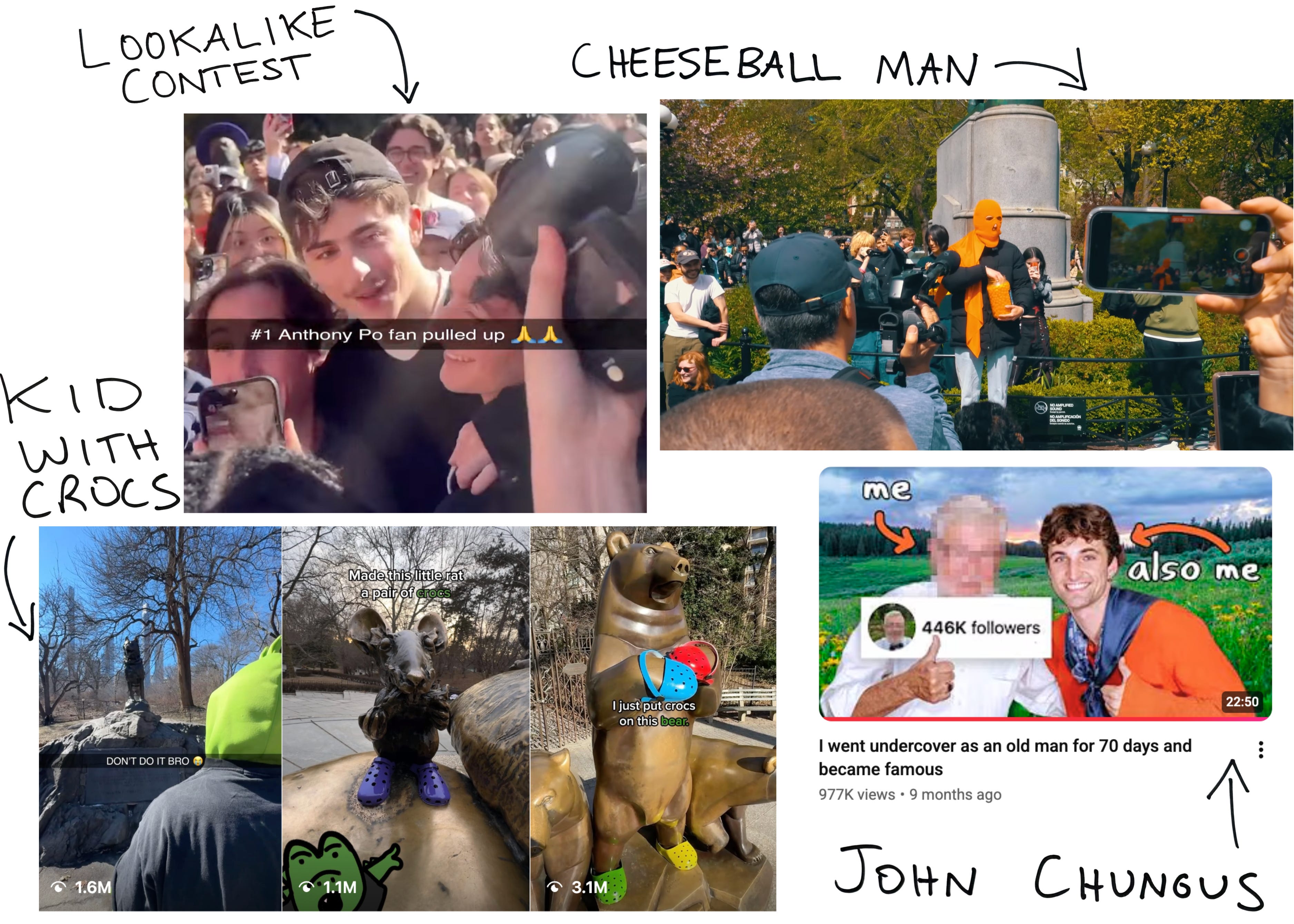
In a recent essay, I wrote about how “breaking through” in today’s attention ecosystem isn’t about views. It’s about participation. I know something is resonating when the more interesting content is being made in comments sections and on personal accounts. I’d argue no one knows how to optimize for that behavior better than Anthony.
When he announced he was starting an agency called Pufferfish with his former MrBeast colleague Talia Schulhof, I immediately knew I’d want to interview them for the newsletter. But I wanted to let them cook first. As the agency approaches one year, I decided it was time to reach out. They’ve now worked with clients like Adobe, Coach, Epidemic Sound, Cash App, and Airlearn. How have they translated their creator instincts into brand momentum?
I talked to Anthony and Talia about how they make something “go viral”, getting buy-in for wild ideas, and why we might see brands make original feature films soon.
Rachel Karten: First, can you tell me a little bit about Pufferfish?
Talia Schulhof: Pufferfish is a creator-led marketing agency and content production studio. My co-founder, Anthony Po, and I started the agency about a year ago. The two of us met while working for MrBeast on the short-form content team in 2023.
We started the company to help brands make content and launch campaigns that are designed to spread online. Most marketers first look toward a brand’s competitors as a hurdle to conquer for market share, but they really should be looking at content creators as their biggest rival when it comes to capturing attention. Brands will not stand out unless they put forth something that is just as, if not more, entertaining than what creators are putting out there organically.
Our experience making viral content on our own accord informs how we advise our clients so that they can think like creators and resonate with audiences as effectively as creators have been since the dawn of the internet.
Rachel: The biggest social media trope is a boss asking their social team to “go viral”. But you’ve marketed your agency as being able to do just that. As Business Insider put it, you’re a “creative marketing company focused on viral stunts that have a cultural impact — both in person and online”. How do you define viral?
Anthony Po: We don’t think of virality as a pure numbers game. We care about the value of a view more than we care about the view itself. We would much rather make a video with 20K views that people leave becoming true fans, as opposed to one with 10M views and the people forget about the video within a day.
Talia: Though we’re positioning ourselves as being able to help clients go viral, I don’t think “viral” is the offering. It’s really just a byproduct of the work we do.
We don’t go to our team and ask, how do we make something viral? We ask, how do we make something funny? How do we make something that makes someone step back and go, I’ve never seen anything like that before? How do we create something people have no choice but to share because it speaks to them on a deep level?
I think the word “viral” has lost its meaning over time. We use it as an all-encompassing term for things that exist on an incredibly broad spectrum of visibility and cultural impact. We call a MrBeast video that gets billions of views viral, but we also call things viral within their respective corners of the internet, even if 99% of the populous has never heard of it. “Viral” as a term feels familiar—it’s a buzzword—so it’s easy to throw it around because most people have a very positive association with the term. But frankly, the depth of reach and the value of a view is probably a much more important metric that we like to focus on. Sure, we can call it success if we launch a “viral” campaign that generates 10B views. But then there are also projects that maybe reach 50K people on a super profound level, and that’s still success in our eyes and perhaps even more valuable.
Rachel: If I asked you to sum up how to make something go viral, what would you say?
Anthony: There’s not a hack for it. It’s a matter of taste, being aligned with zeitgeist, and being able to execute upon something that you believe people will be delighted by.
Talia: “Viral” comes as a result of people spreading a message, and people don’t spread a message without a reason. It really comes down to the psychology of speaking to your audience in a way that resonates, whether that’s making them laugh, making them care about an issue through poignant storytelling, or making something so novel they feel compelled to send it to someone they care about.
If you approach content creation with how you can make someone feel rather than just what you are objectively presenting to them on the screen, you’re tapping into the emotions that will ultimately get the content to spread (or to go “viral” for lack of a better term).
Rachel: Based on your work, I’d imagine you pitch clients some wild ideas. How do you get buy-in?
Talia: This is really at the heart of what we do, and also at the heart of what makes a client a good fit. The work we do isn’t for everyone, because in order to engineer the successes we’ve had, we have to take risks and do things that have never been done before.
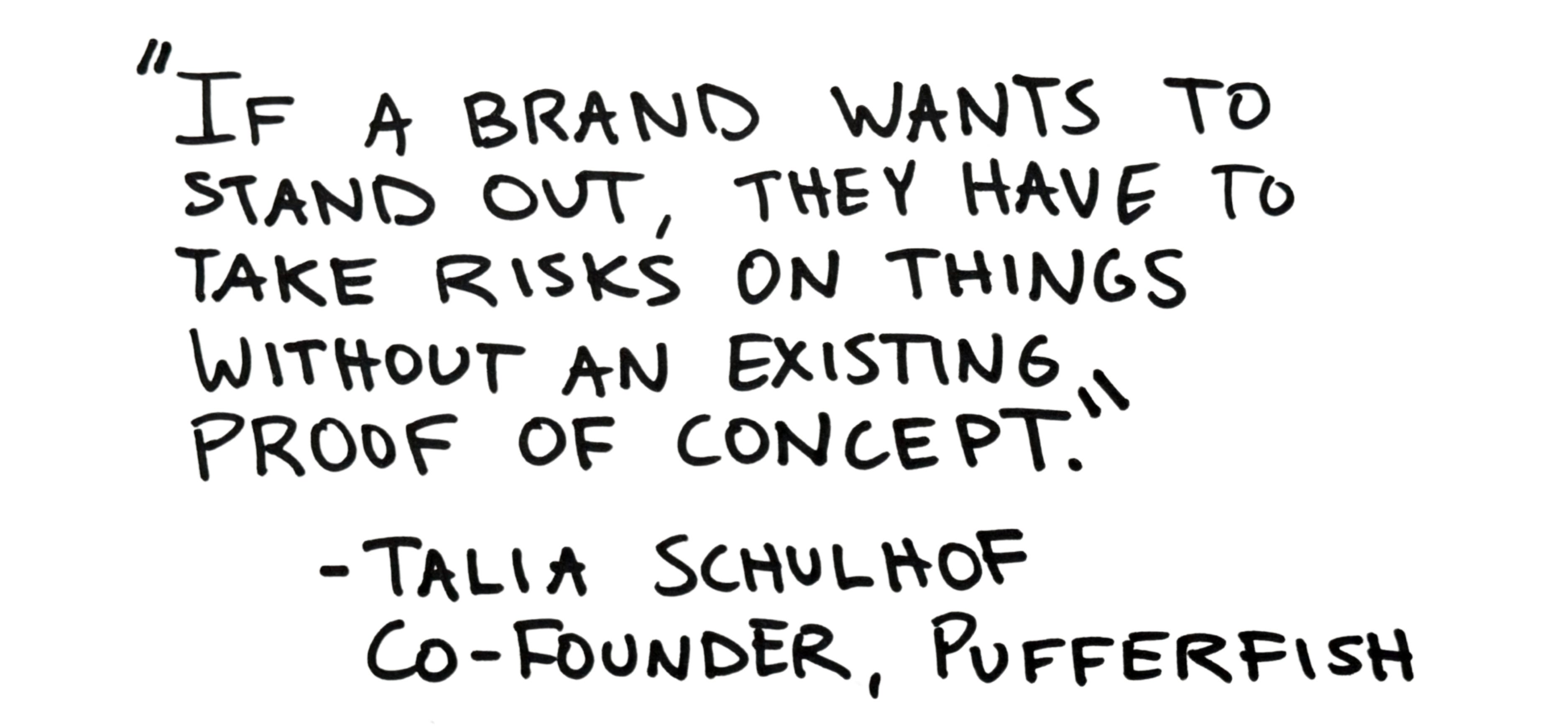
Marketing teams often want data to back up an idea, a proof of concept, examples of similar things that have worked before. That’s not what we’re trying to do. We’re trying to do things people have never seen, which means there’s often no proof of concept, and that can make buy-in harder. But everyone who’s ever done something revolutionary was the first to do it. If a brand wants to stand out, they have to take risks on things without an existing proof of concept.
Sometimes getting buy-in is about picking the right partners who give us that flexibility and trust. Other times it’s about grounding the foundation of an idea in something familiar, then making strategic tweaks that bring it into new territory while it still feels comfortable enough to convince the powers that be.
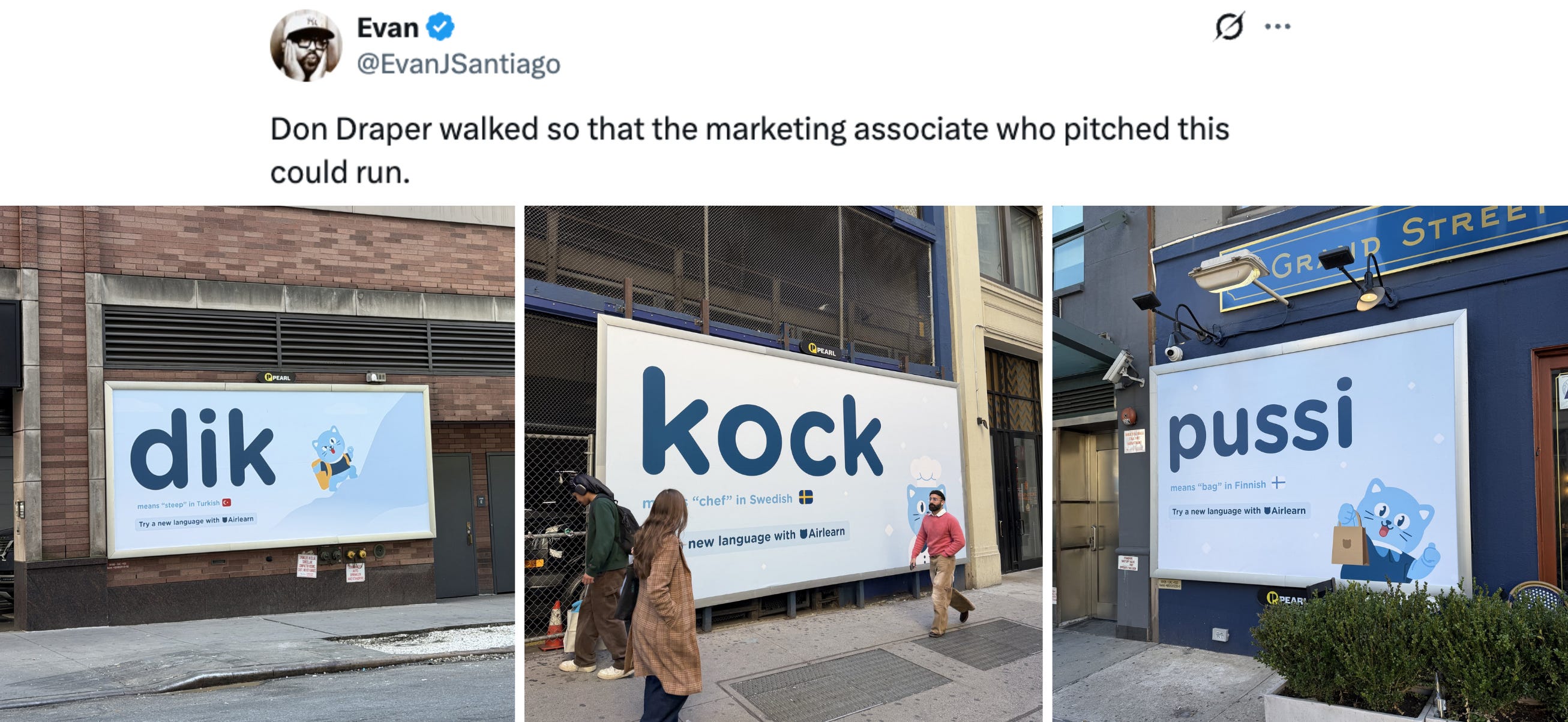
We literally proposed putting the words ‘kock,’ ‘dik’, and ‘pussi’ on billboards for Airlearn (they all mean innocent things in other languages). I remember pitching it on a call with the CEO, and after I finished speaking there was at least fifteen seconds of silence. I thought to myself that we’d just lost the client. Then the CEO said, “I love it. Let’s put kock in Times Square.” It came down to pitching with a great graphic and explaining exactly why it was aligned with the brief. As long as a concept speaks to the overarching brand goals, a wild idea can be justified.
Where we’d struggle to work with a client is if, even when all signs point to yes, and the idea achieves what they need and stays aligned with the brand, they still say no because it feels too out there. That probably means we’re not the right agency for them, because we’re looking to push boundaries, not make what feels safe.
Rachel: You both come from the creator world and deeply understand today’s attention ecosystem. What typically stops brands from producing the type of content that actually breaks through?
Anthony: People and brands who don’t consume modern-day culture are going to do a bad job at producing content. How are you possibly going to make the things people care about if you don’t care about it yourself? CMOs should be consuming content constantly. If you’re in charge of a brand, and you don’t feel passionately about consuming culture, you’re fighting an uphill battle.
Rachel: When I try to pull a through-line of the type of work you do, I come back to participation. You’re usually building wonder and mystery, that ultimately gets people to post about the thing you’re doing. How do you get people to participate? Especially if the participation is driven by a brand? I loved the Cash App campaign with Azzi Fudd where you sent fairy godmothers to Uconn to grant students’ wishes.
Anthony: I think participation is a great way to describe it, not only in the physical aspect, but also in the ability to share a story with your friends. Ultimately, the internet should be a place that is exciting and fun to be a part of, and that’s the internet that I came from in the late 2000s. So for us, whether the participation is showing up to a park or having excitement about contributing to a comment section on a video, participation is a great way to articulate our through-line.
Talia: For brand work to succeed, it has to be an exchange between brand and audience. Getting people to participate is a matter of integrating it into the idea from the get-go and making sure it gives way to digital or IRL participation, or both, depending on the concept.
With the UConn activation, we added things beyond just posting on Cash App’s brand page—we planted a lot of UGC, we worked with UConn students as PAs who posted on Yik Yak and got the conversation going among students. A ton of videos from the student body cropped up in response. We made a moment on campus so irresistible that people couldn’t not share it. We want to create moments where people feel like they can film something, report on it, maybe go viral themselves.
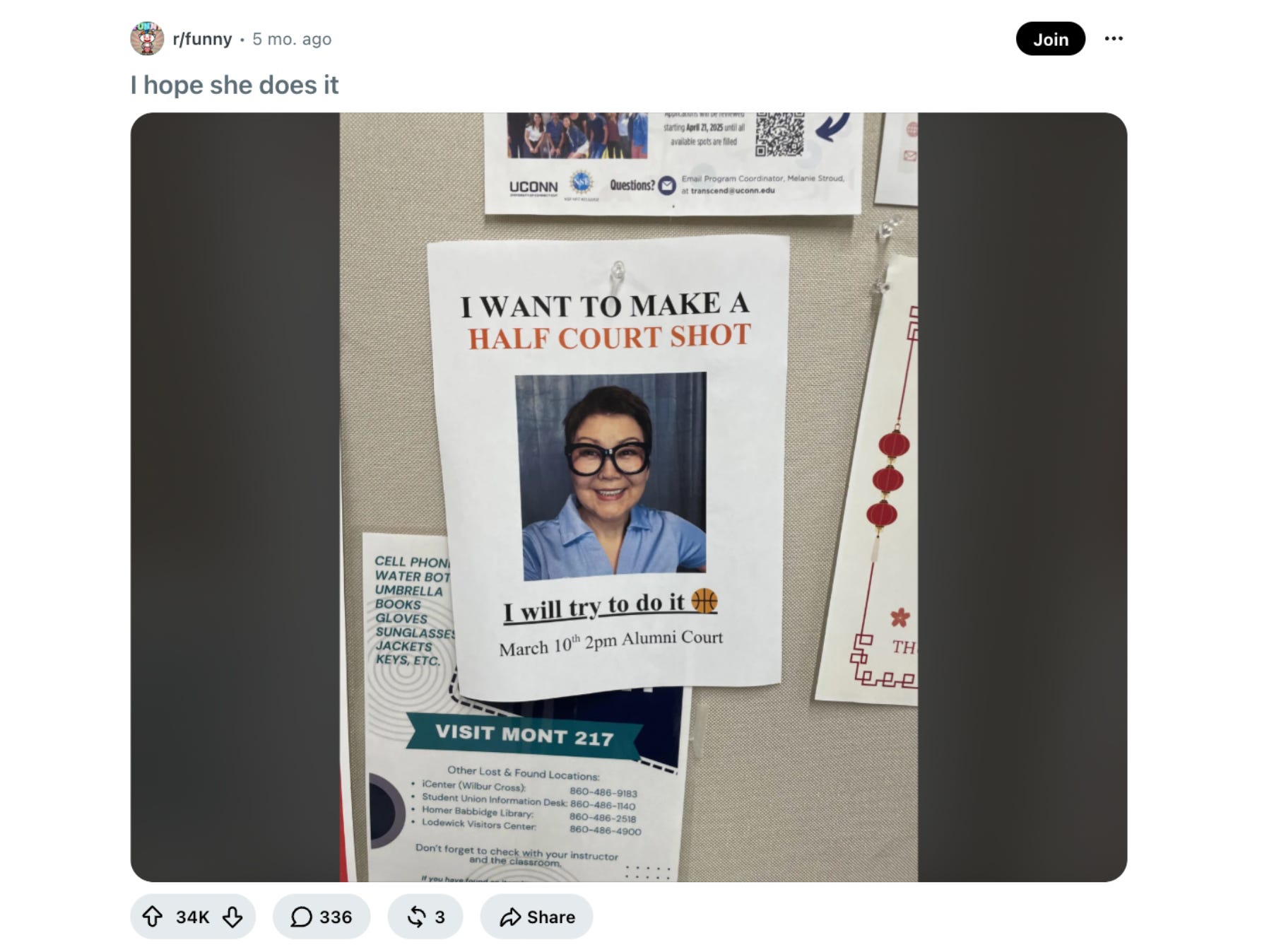
A lot of people have their very first experience with virality providing coverage on something else, whether it’s filming a concert, clipping a YouTube video, or posting a reaction to a clever marketing campaign. The fact that the discussion and participation can reach similar heights of visibility as the source material is exciting, and it encourages audiences to participate even more.
Rachel: You spend a lot of time on the platforms. Have you noticed any shifts lately?
Anthony: I think the biggest shift is that people are becoming much more attuned to content that’s clearly engineered to perform metrics-wise rather than made because someone genuinely cared about the idea. Generative AI has accelerated that, because people are surrounded by so much manufactured content now that they’re getting better at recognizing it. So you’re seeing a real backlash toward creators who feel more like businesses than people, because once it becomes obvious that something is optimized primarily for virality and monetization, audiences check out emotionally even if they still click.
Rachel: What do you love about social media?
Anthony: It allows me to pay creative people and those younger than myself. It also allows me to delight people through satellites and a bunch of wires in the ground, which is really a crazy thought.
Talia: I am who I am today because of social media. My creativity was shaped by it from the time I was eleven or twelve, posting on Tumblr and making secret photography Instagram accounts.
I love how social media, in its current form, democratizes entertainment. A random kid in their bedroom in a small, one-horse town can have an idea, pick up a phone, and make something that speaks to a lot of people. It’s leveling the playing field so new stories get told and creative minds get discovered in ways that weren’t possible.
I’ll acknowledge that social media comes with its fair share of issues, but it’s been revolutionary for entertainment, and it’ll be the single most influential force on the way we consume entertainment for the foreseeable future.
Rachel: What do you hate about social media?
Anthony: It’s become commodified. There’s always so much money to be made within it, and therefore it’s become opportunistic. I also have noticed that a lot of bad actors have come into this space specifically over the past seven years.
Talia: One thing I hate about social media—and this is also what makes our work hard—is that it puts performance, quantified, on display for everyone to see, and that has a psychological impact on both audiences and creators.
Netflix can put out a show, and the general public never has to know the viewership numbers; the viewer thus goes into watching it with an open mind. The closest equivalent to the display of success (or failure) for a Netflix series is probably something like Rotten Tomatoes. But on social media, when you make content, your failure or success is on direct display in the form of a like count and a view count that everyone watching can see. People are subconsciously influenced by the social proof of seeing likes on a page. It’s like a laugh track in a sitcom, an indication of ‘you’re supposed to laugh here.’ A high like count tells people ‘you’ll probably like this too,’ and that’s why it gets pushed out further to more people. What I hate is that we’re encouraged to make things that yield vanity metrics. That takes a lot of the art and soul out of making content.
Rachel: Look into your crystal ball. What’s next in the world of brand social?
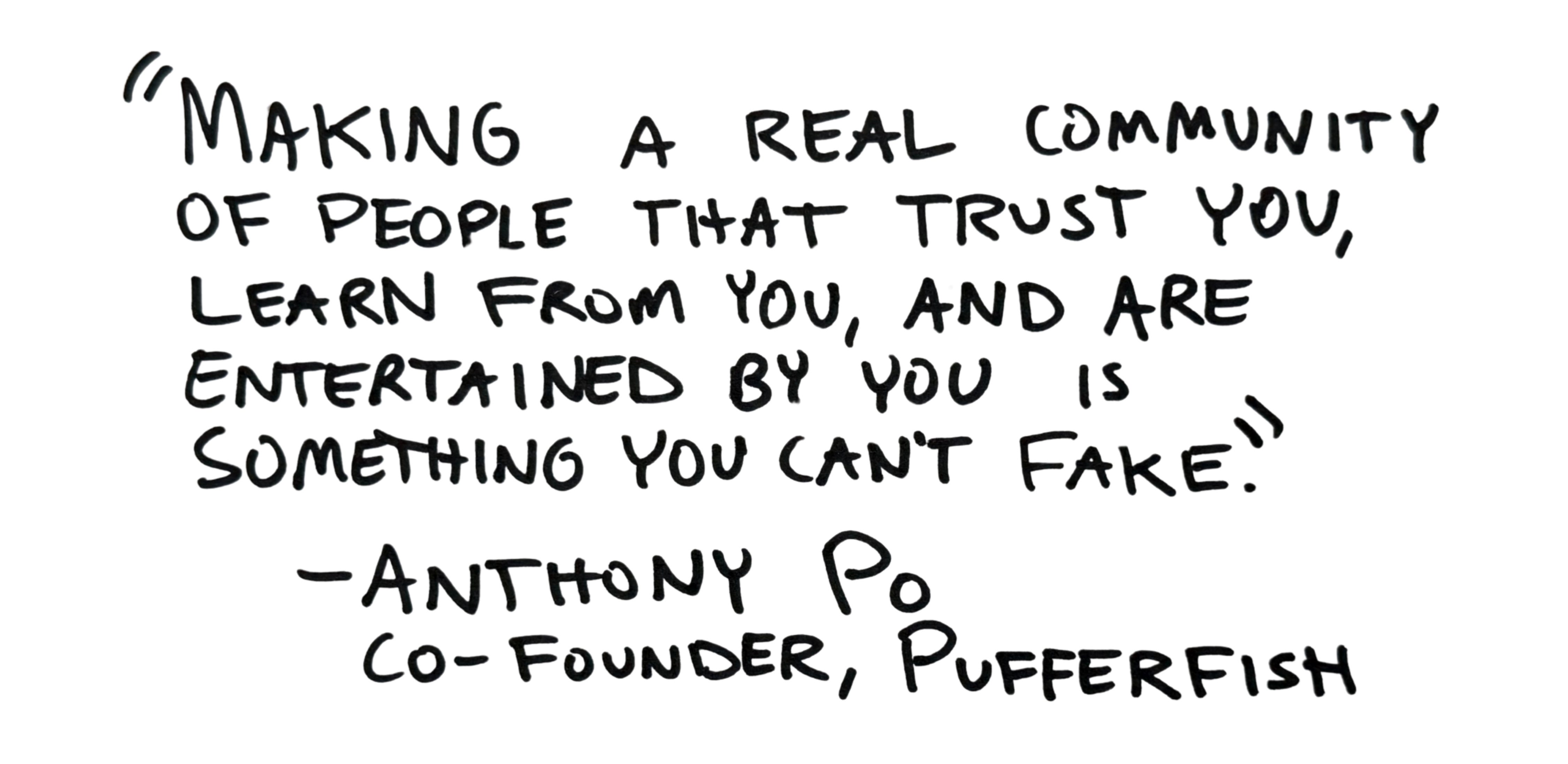
Anthony: Providing real value to real people. There are a lot of bots on the internet, and there’s lots of views to go around; but making a real community of people that trust you, learn from you, and are entertained by you is something you can’t fake.
Talia: I can never say for certain what’s next. We’ve gone through a lot of waves. Usually trends or cultural moments are pioneered by individuals and have a life cycle until they become overplayed. We saw that with lookalike competitions; hilarious and novel for the first few, but then it’s like, ‘okay, we get it.’
Something that I foresee coming into play a lot more frequently is brands playing in spaces where they “don’t belong.” I mean, A24 just opened up a restaurant in the West Village. But the most prominent example here is brands operating more like film studios. Once everyone picks up on the fact that people just want to be entertained, and positive brand association is an easy byproduct of that, brands will make huge investments into storytelling and distribution. It feels dystopian, but I wouldn’t rule out brands making original feature films that are layups for exclusive product integrations. We’re probably closer to that than we think.
Check out the Link in Bio Job Board
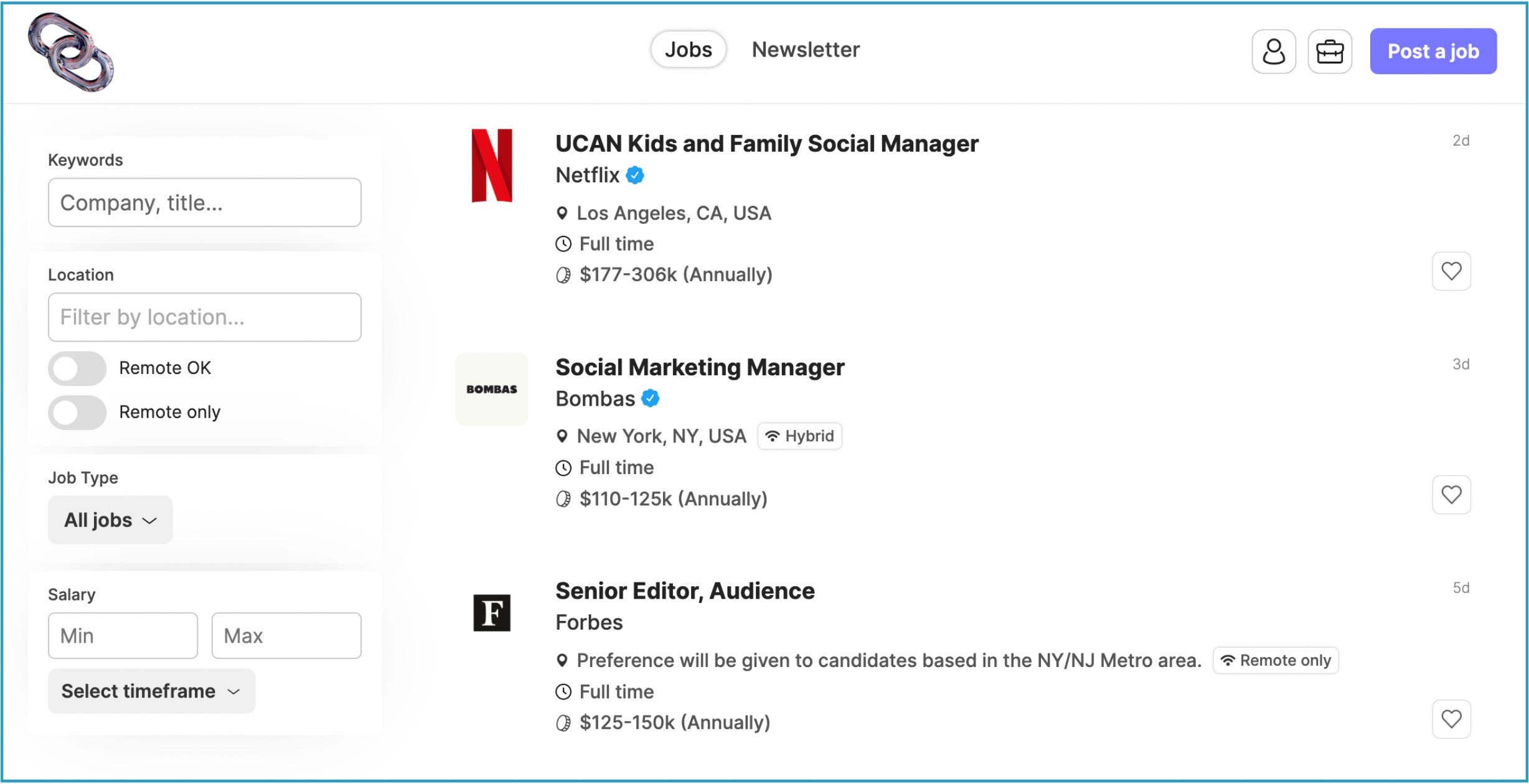
The Link in Bio Job Board features all of the best social media roles in one place, updated daily. Right now there are roles from places like FIGS, Glossier, Netflix, and more.
If you work for a brand that’s hiring within social media, this job board is for you too. Post your job listings to get in front of talented social media marketers.
Thanks so much for reading. If you enjoy free interviews like this one, you can upgrade to a paid Link in Bio subscription. You’ll get weekly strategy newsletters and quarterly trend reports, along with access to the Discord community.
I want to note that this newsletter is an educational resource and can likely be expensed through your company. I have even written a handy template for you to use when asking!
If you’re already a paid subscriber, thank you for making Link in Bio possible!
I love the big takeaways in this. It makes me want to experiment more. Maybe try launching something while I fight through unemployment and build something I can point to. Don’t know. Thanks for this interview!
This is such a great interview; I actually grew up watching Anthony's content, so it's interesting to hear his voice through the lens of a peer in the comms world. Thanks for covering this!