


“We wrote speeches for the For You page.” That’s Annabelle Long, lead speechwriter for Senator-elect James Talarico, talking about the role social media played in the campaign. “Everything was designed to work in the room AND be consumed in clip-sized increments.”
While there are many theories on the tides that led to last week’s blue wave, one thing is clear: a sophisticated social media strategy is essential to political mobilization. As Parker Butler, co-founder of Luminary Strategies, posted, “2026 is the election where organic attention overtook paid media as an electoral force.” After all, algorithms essentially work like targeted ads now. There’s no visibility ceiling on organic content when you know how to build posts that move people.
Paulina Mangubat, Deputy Chief Mobilization Officer at the DNC, knows this well. She’s spent the past few years rebuilding how the organization shows up online. It’s working. This election the DNC posted thousands of times, got over 13B views, and reached five times more users than in the 2024 cycle. In today’s guest post, Paulina shares the playbook.
This past May, a stranger appeared outside my house and started recording me with his iPhone.
“Paulina, why did you choose to call Stephen Miller an ‘ugly fuck’ on the Democrat Party’s account instead of putting your name on it?”
I was with my mother, who was visiting from Arizona to help with wedding planning, and my fiancé, Mikhail. I didn’t answer as we rushed to the car. The man put his phone into his pocket and retreated up the street.
In total, the interaction lasted probably under 30 seconds. Seven months and one midterm election later, I still find myself ruminating on it.
I got doxxed by Katie Miller because of a work tweet. It happened soon after James Talarico won Texas’ U.S. Senate primary, and I published a photo of him on the official @TheDemocrats account to celebrate. Stephen Miller, one of Trump’s ugliest and most xenophobic goons, quote-tweeted us with a transphobic “joke.”
In another time, perhaps our team would have ignored this. But I knew we had to be bold. I typed five short words and sent them up for approval. 15 minutes later, the post went live on the official Democratic Party’s X account. To date, it has been viewed over 59M times.
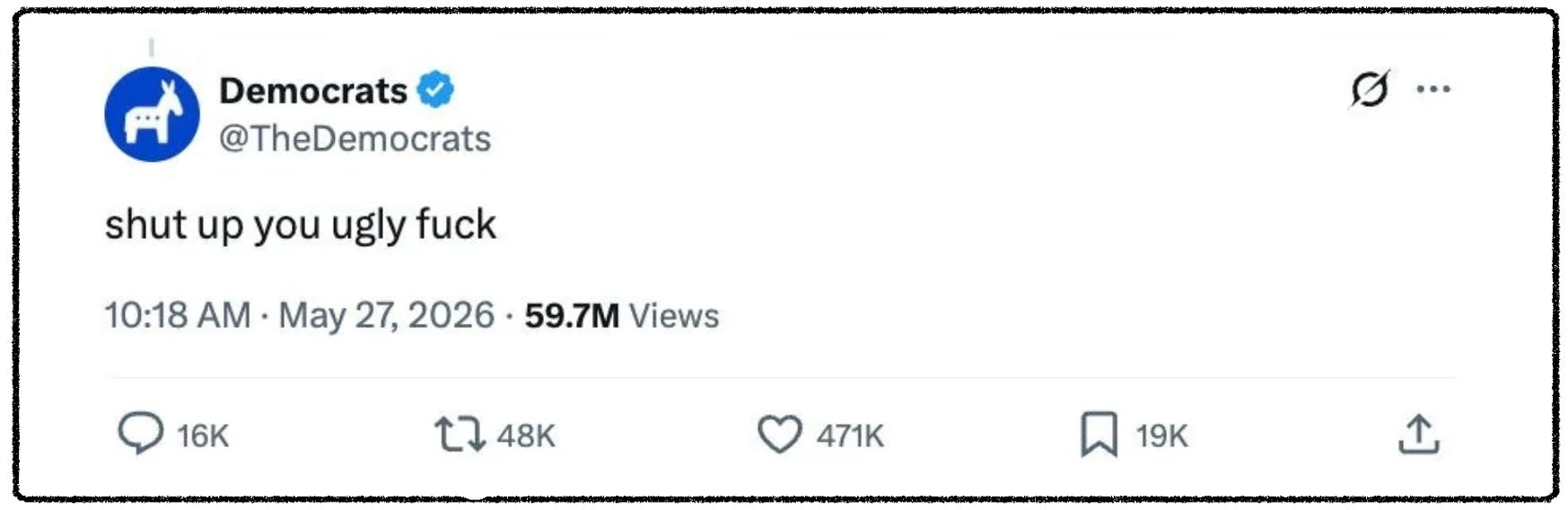
The virality of “shut up you ugly fuck” shocked many on both the left and the right. We had broken containment. But the real success story is how my team and I spent over a year overhauling the tactics used across the DNC’s social media program in order to create the conditions under which this tweet could be written in the first place.
After the Harris-Walz campaign’s loss in 2024, I found myself at the helm of a content program bombarded by criticism from all sides. Everyone was lambasting Democrats for not doing enough; commentators bemoaned the lack of a “Joe Rogan of the Left.” Much of the criticism focused on policy matters over which my team had no control, and on the decisions of elected officials with whom I had never even been in the same room.
I tasked myself with answering a question: With the reality of the GOP’s trifecta out of my control, what could we change about our program to make us succeed online?
In the end, my team posted thousands of times this year and last, reaching five times more users than in the 2024 cycle and garnering more engagements than the Trump White House. To be clear, we were just one piece of a giant ecosystem built primarily to support campaigns on the ground. Those teams deserve much of the credit. But I believe the changes we made helped us be better partners for those campaigns and more effective stewards of the Democratic Party brand.
Here’s how we did it—and the takeaways that might apply to any digital team trying to break through right now.
We reduced as much friction to posting as possible.
Our approvals process now involves sending proposed content into a Signal group with representatives from the DNC’s research, press, and legal teams. After 15 minutes, if nobody raises an objection, the post goes live.
The “15 minutes” and “Signal group” components of our approvals process are key to a functional rapid-response operation in the modern era.
On political campaigns, press teams exert a ton of influence over social media teams, often functioning as the main content “approver.” Researchers and lawyers are typically also included as “approvers.” In the past, I’ve been on approval chains that have required individual sign-off from 15 stakeholders—all for a single tweet meant to respond to the news of the day.
At the DNC, our old approvals process actively disincentivized the social team from trying new things. Who had time to think outside of the box when a post took three times as long to approve as it did to draft? Everything the team wrote was totally optimized to reduce friction on an approvals chain made up of staff who didn’t even use TikTok in their personal lives.
In a way, approval processes are like a stack of Swiss cheese: There are ways to get through each level of approval, but if you’re layering 15 different slices of cheese on top of one another, not much of anything is going to get through. I’ve found that two or three slices are much more manageable.
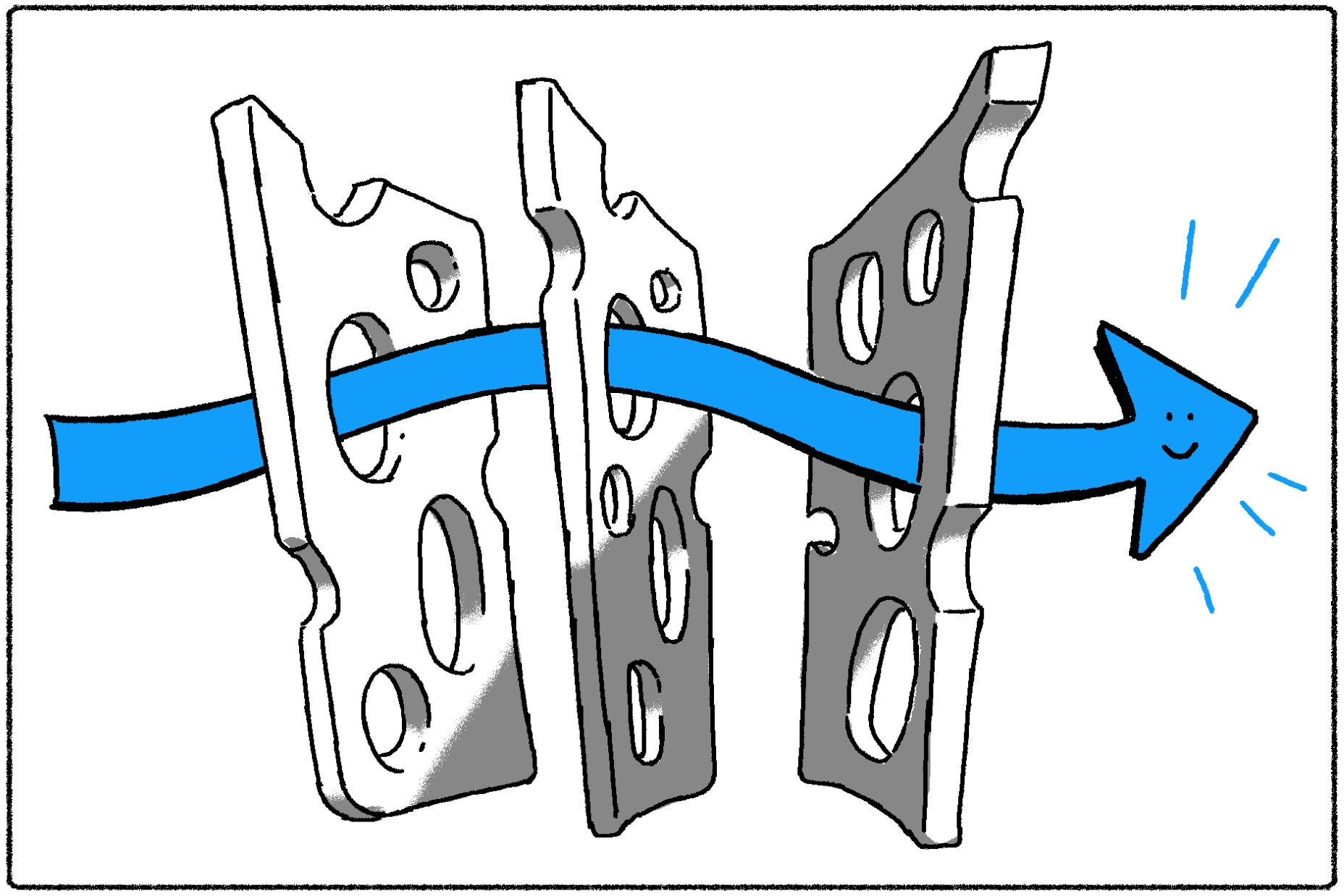
Moving to the rapid approvals model has saved us a lot of time, but I actually believe the biggest benefit isn’t the speed: It’s that my team is now empowered to actually try new things without dreading a grueling approval process.
We stopped treating our main account as our only priority.
In January of 2025, under the leadership of Arlie Shugaar, my team launched @FactPostNews—an unbranded news account with very little blue in the logo and no Democratic donkeys in sight.
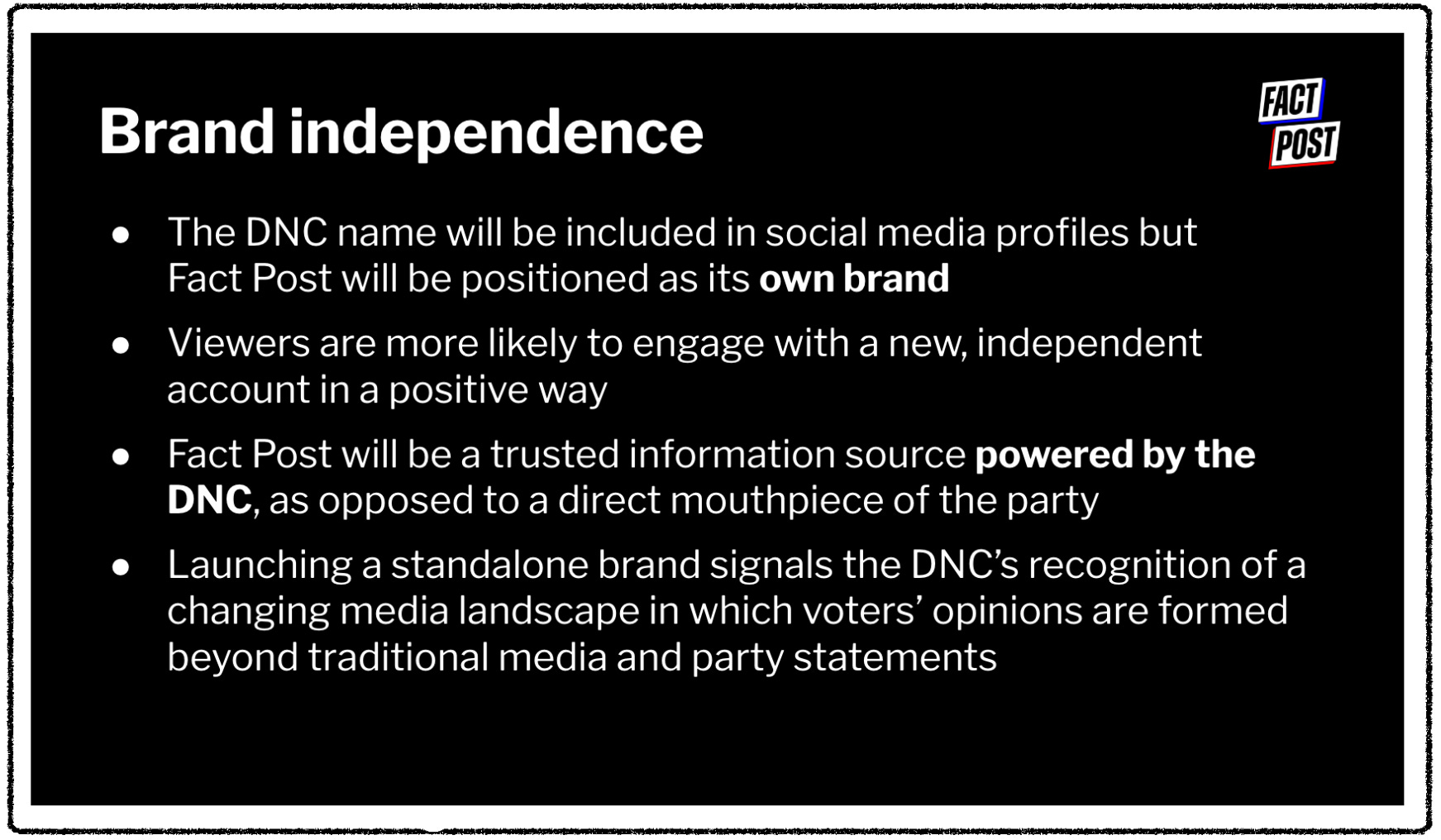
I believe setting up a multiverse of unbranded accounts is the future of digital campaigning. News accounts like PopCrave and Courier are mainstays on my feed. Recently, DemzDeliver has gone viral many times over on X with its constant coverage of Democratic wins. And Arlie eventually went on to relaunch KamalaHQ, one of the most valuable pieces of digital infrastructure in the space, to simply HQ—Headquarters—earlier this year.
By all measures, FactPost has been a resounding success, delivering 4.8B impressions since launch. It has allowed us to seamlessly seed new discourse cycles that pushed broad Democratic Party messaging in a way that’s compatible with how people process information in 2026.
With the way algorithms are set up, it’s never been easier to go viral on an account with very few followers. I’ve found that posts originating from FactPost were also far more likely to be picked up by meme accounts and aggregators, likely because of the lack of overt branding.
Then there are the benefits these unbranded “burners” have for your main account. When I worked on the Harris-Walz campaign in 2024, on more than one occasion we found ourselves wanting to add Vice President Harris’ thoughts into an ongoing conversation via quote-tweet, but struggling to find the perfect post for her to engage with. Creating FactPost solved this problem for us, allowing us to tee up memorable moments for the main @TheDemocrats account—a social media alley-oop, if you will. It’s crazy how slightly more intentional wordsmithing can make it so much easier for elected officials to get in on an online conversation.
Finally, having unbranded accounts enabled us to get more creative with how we presented our messaging. Here, our “sexy government services” memes come to mind.
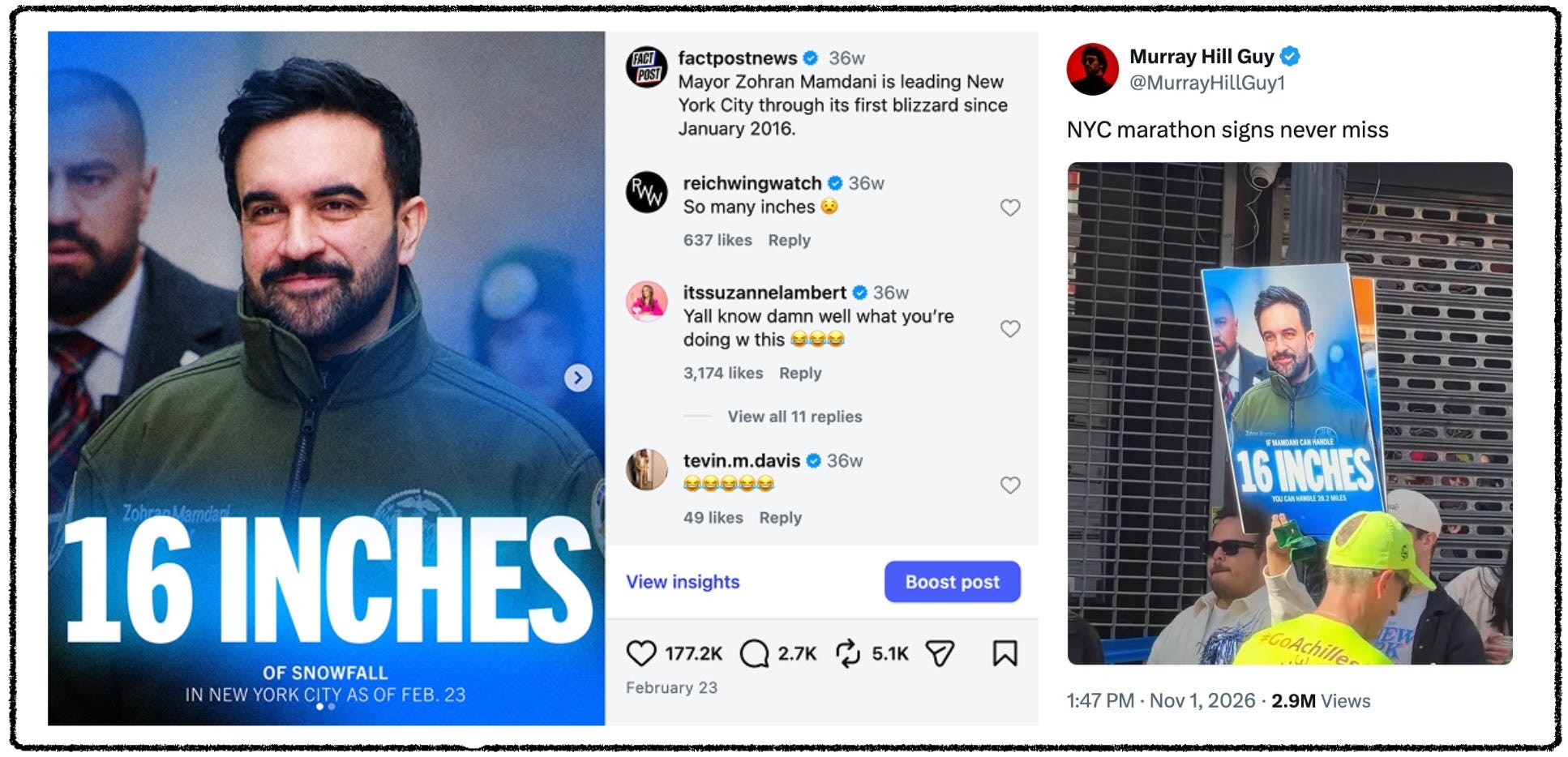
These images would not have made much sense originating from the official @TheDemocrats accounts, so we posted them only to the FactPost Instagram account. Users quickly downloaded the memes from Instagram and moved them to other platforms without prompting. Now, these images are ubiquitous in comment sections across the internet. They even made their way into the New York City Marathon.
We built a system for giving creators clips, then let them cook.
If you are posting content that is actually worth watching, it’s going to get aggregated by random accounts.
In the past, I’ve been on political campaign teams that have been obsessed with putting the principal’s account at the center of every online conversation. I’ve had bosses who have fretted about other posters outperforming us using our “proprietary” content.
For better or worse, the internet is now in its “Death of the Author” era. The best digital teams are the ones that aren’t precious about being credited as the “OP” (original poster) and instead focus on making it as easy as possible for other posters to aggregate and spread their messaging.
This year, we collaborated with almost every single major Democratic statewide campaign to build a massive creator program with one goal in mind: aggregation.
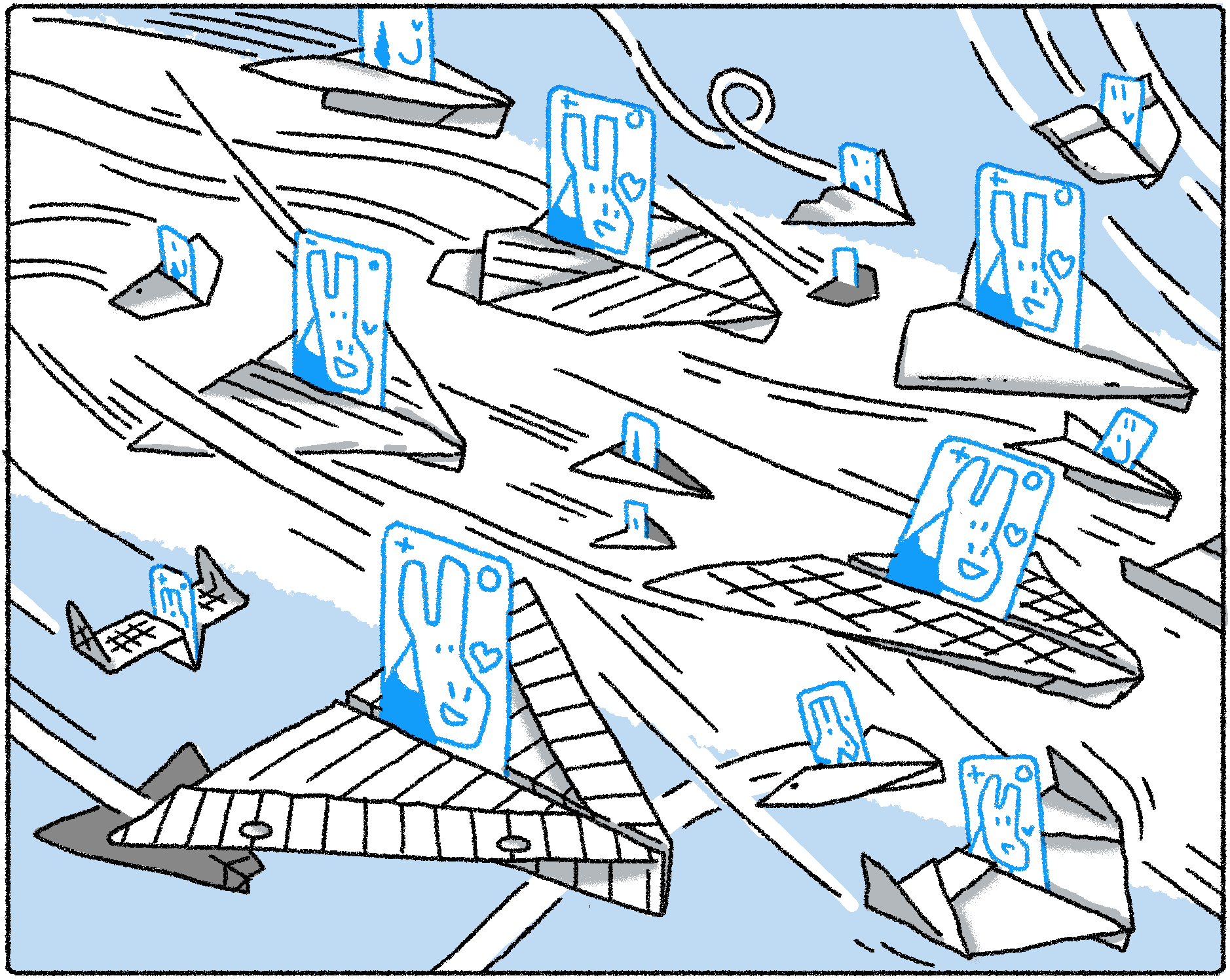
For some context, after 2024, much of the DNC’s digital team was stripped for parts, and a lot of the influencer and creator program that had been built to service the presidential campaign was lost. During the Biden-Harris years, the Democratic Party had an endless array of exciting events to invite influencers to. Creators took photos with President Biden in the Roosevelt Room. They sang pitchily, but earnestly, at Vice President Kamala Harris. They descended upon Chicago to watch thousands of red, white, and blue balloons rain down on the Democratic National Convention.
In early 2025, we had to start from scratch—and I wanted to do it with an eye towards building a program that actually lasted, rather than disappearing at the end of the election cycle.
At the outset, much of the conversation around content creators in the Democratic space was focused on money. Should Democratic candidates pay creators? If so, how much? And how should those payments be disclosed?
The DNC doesn’t pay creators. There are nonprofits and independent expenditure groups that are better-positioned to do that. And so, in the absence of exciting White House events and financial compensation, we had to find a new way to provide value to creators.
“To be honest,” a political creator told us at the time, “We just kind of want clips.” A switch flipped.
One of the most effective things that Matt Rein, our Influencer & Creative Partnerships Director, did this cycle was create a clip library that any creator, big or small, could join to receive a constant stream of clips to download.
The DNC operates a Signal chat with over 700 creators, and we send dozens of clips of Trump and Republicans—as well as clips of Democrats, particularly our midterm candidates—every single day. These creators have a combined following of over 175M, and, to date, have added millions of impressions to our clips.
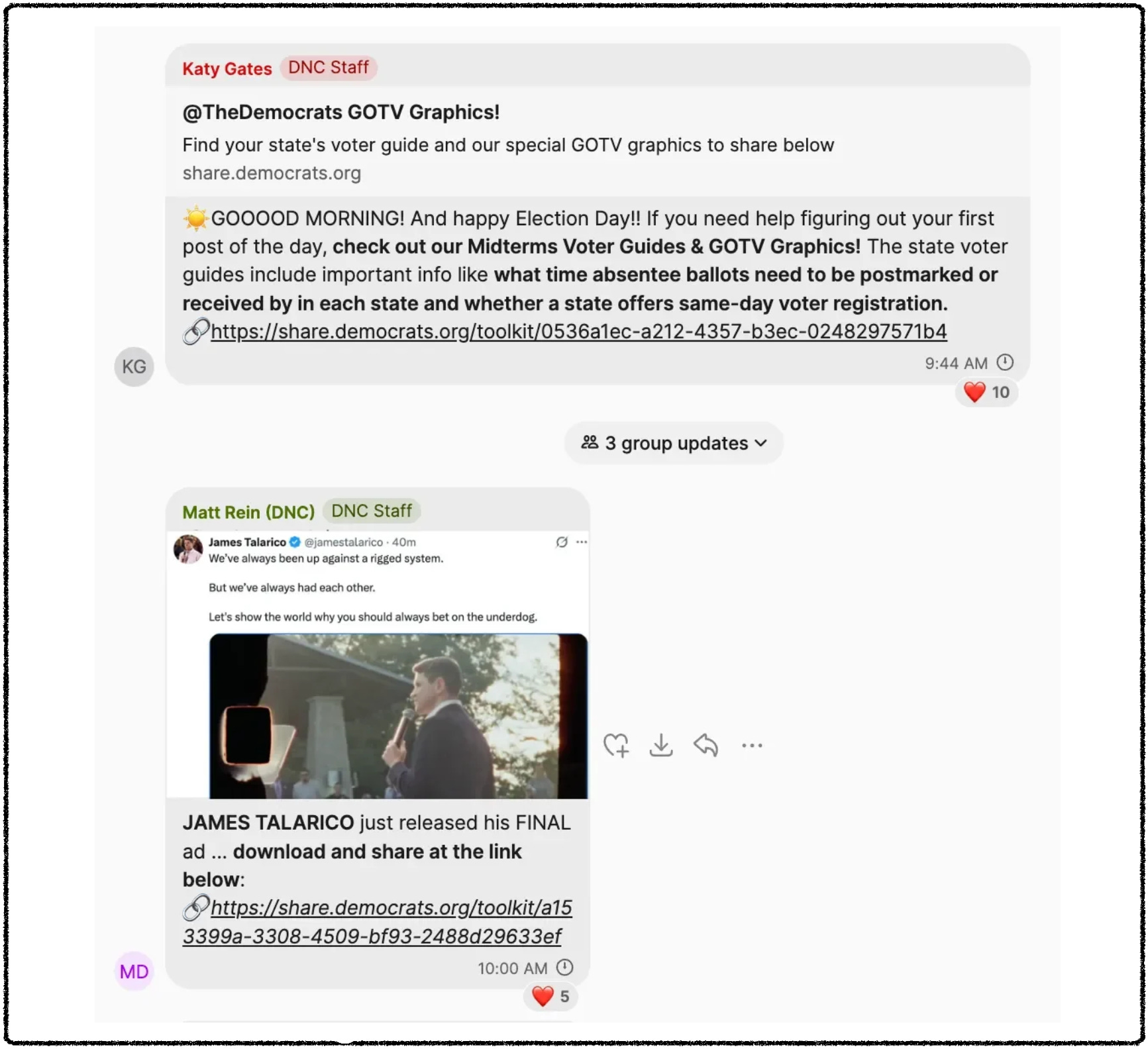
Crucially, the content we send out to our partners doesn’t contain specific messaging directives or talking points. The goal is to signal to folks what we think their audiences might find interesting—not to tell them how to talk about any one issue.
Our approach is the inverse of what I’ve noticed happening on the MAGA side of the internet, which is rife with AI-generated Trumpslop and relentless copypastas that are obviously coordinated.
Over time, we added the digital directors of every battleground U.S. Senate and gubernatorial race as administrators to our clip library, allowing campaign teams to immediately send their highest-priority clips to creators—including many with smaller, more local audiences.
Content creators aren’t always keen on reposting content that has already been uploaded by an account; instead, they’d much rather download a clip themselves and repost it with their own spin. That behavior should be encouraged even if the reach metrics aren’t reflected in your actual campaign account, as it helps create a natural “surround-sound” effect on feeds.
Creating a centralized clip repository ultimately expanded the digital reach of midterm campaigns in races that came down to thousands, if not hundreds, of votes.
We made sure we were multilingual in the languages of the internet.
The Democratic Party is a big tent, but algorithms are increasingly becoming more and more personalized. No two feeds are alike, and social media has evolved such that users will typically only see content that’s most relevant to them (or, rather, content that the algorithm presumes is most relevant to them).
Every single social media platform has its own cultural mores and conventions that make some concepts fly and others tank.
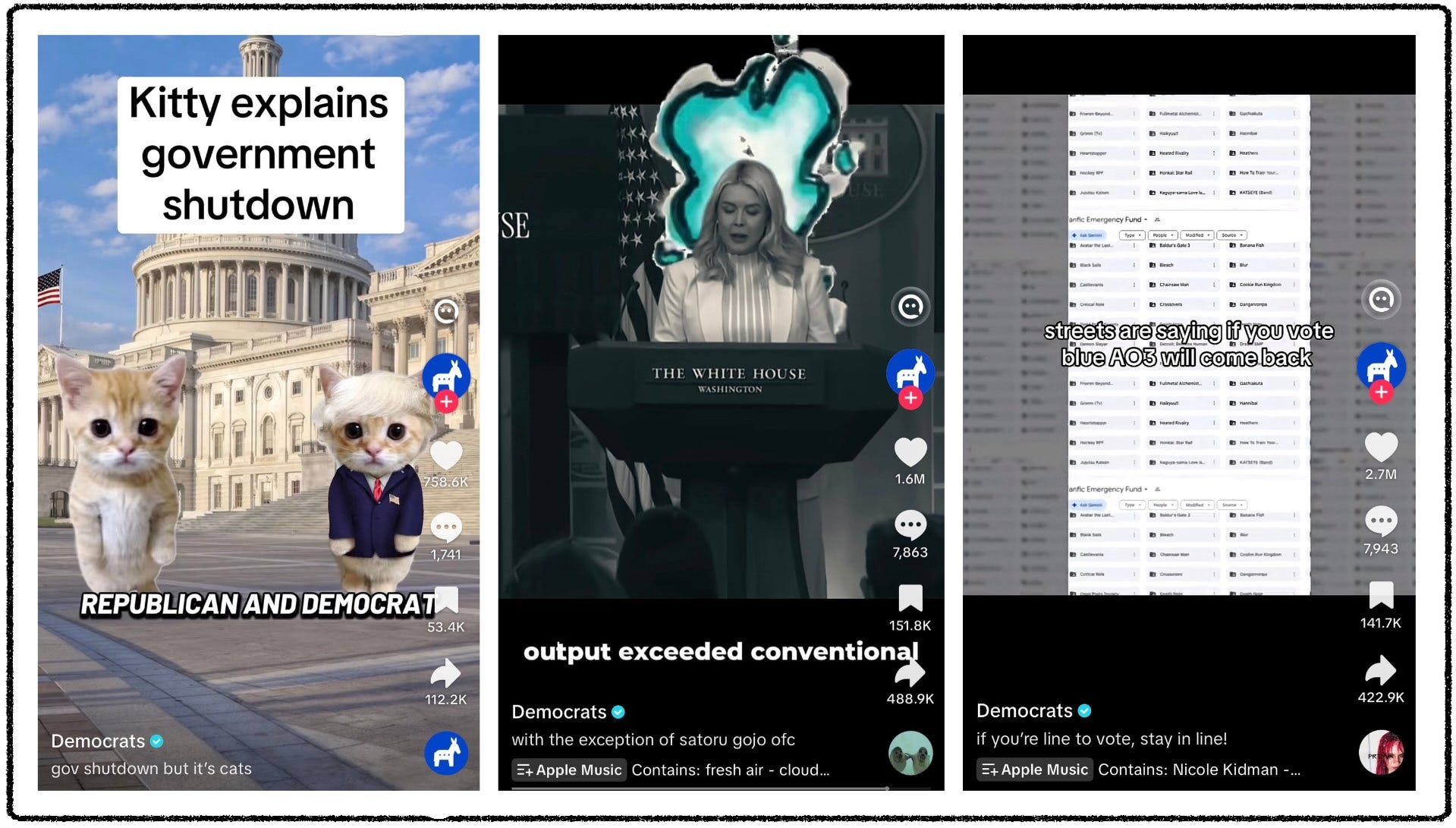
During the Republican-induced government shutdown last year, our team created an explainer video featuring cats that went nuclear on TikTok, quickly collecting over 750K likes on the platform. When we took a risk and crossposted it to X, many people were confused.
“Who is this for?” several Twitter politicos demanded. I think it taught the team a valuable lesson.
If you want to reach the most people possible, you have to create unique pieces of content tailored for different feeds. Some of our most successful posts were TikToks riffing on anime themes or making cultural references that, filtered through the hardened perspective of a cynical X native, might seem cringe. But the reality is that on other platforms, those kinds of posts helped us break through to new audiences who weren’t on Election Twitter and didn’t care much about politics at all.
One TikTok we made, an edit mocking Karoline Leavitt with a Jujutsu Kaisen reference, earned 8.8M views—and over 65% of them were young men. The best thing that a digital strategist can become is multilingual in the language of the internet.
Take Facebook, for example, a platform that feels spiritually antithetical to TikTok. To be honest, no one on my team really uses Facebook anymore. Many of the youngest coworkers—fresh college graduates, more or less—have never even used Facebook at all in their personal lives. But in the past year, Facebook has been a massive growth engine for the DNC’s social program, delivering 397M impressions and 36M engagements from an algorithm that obviously favors boomers and Gen-Xers, but also includes a non-negligible number of millennials.
We achieved the above growth by adapting our biggest hits from X into a more Facebook-ready format: Simple stacked photos showing contrast or interesting imagery paired with long-form copy more similar to a news article than anything else.
As social strategists working in politics, it is easy to get caught up in the drama of Twitter or the addictive eccentricities of TikTok. Familiarizing yourself with the language of each individual platform and learning how to code-switch accordingly will ensure you don’t leave any impressions on the table.
We thought like a fan account.
In the past, our social program focused on being the official voice of the Democratic Party—emphasis on “official.”
But in the past two years, we’ve moved away from primarily using our accounts to make Official Statements about current events and invested heavily in creative tactics most often deployed by fan accounts. After all, we’re @TheDemocrats—who better to lead the parade of people libbing the fuck out?
In building out our TikTok, I prioritized hiring producers who have deep ties to online fandoms, from sports to Olivia Rodrigo to Attack on Titan to Andor. We weren’t the only ones to do this: the Lionsgate TikTok account is full of slick CapCut edits set to trending audios. And because our goal was to make our viewers feel something and connect with our candidates, leaning on the language of fandom was especially helpful.
In 2025, I made a TikTok edit set to “What It Sounds Like” from K-Pop Demon Hunters to celebrate the election of Mayor Zohran Mamdani, Governor Abigail Spanberger, and Governor Mikie Sherrill. I paired lyrics about destruction and hopelessness with imagery of the Trump administration, then added scenes of our Democratic candidates to accompany verses about hope and renewal. On TikTok, the edit has 2.9M likes. This year, I updated the edit by making it more cinematic and longer to reflect our expansive slate. The 2026 version now has 4.1M likes and counting.
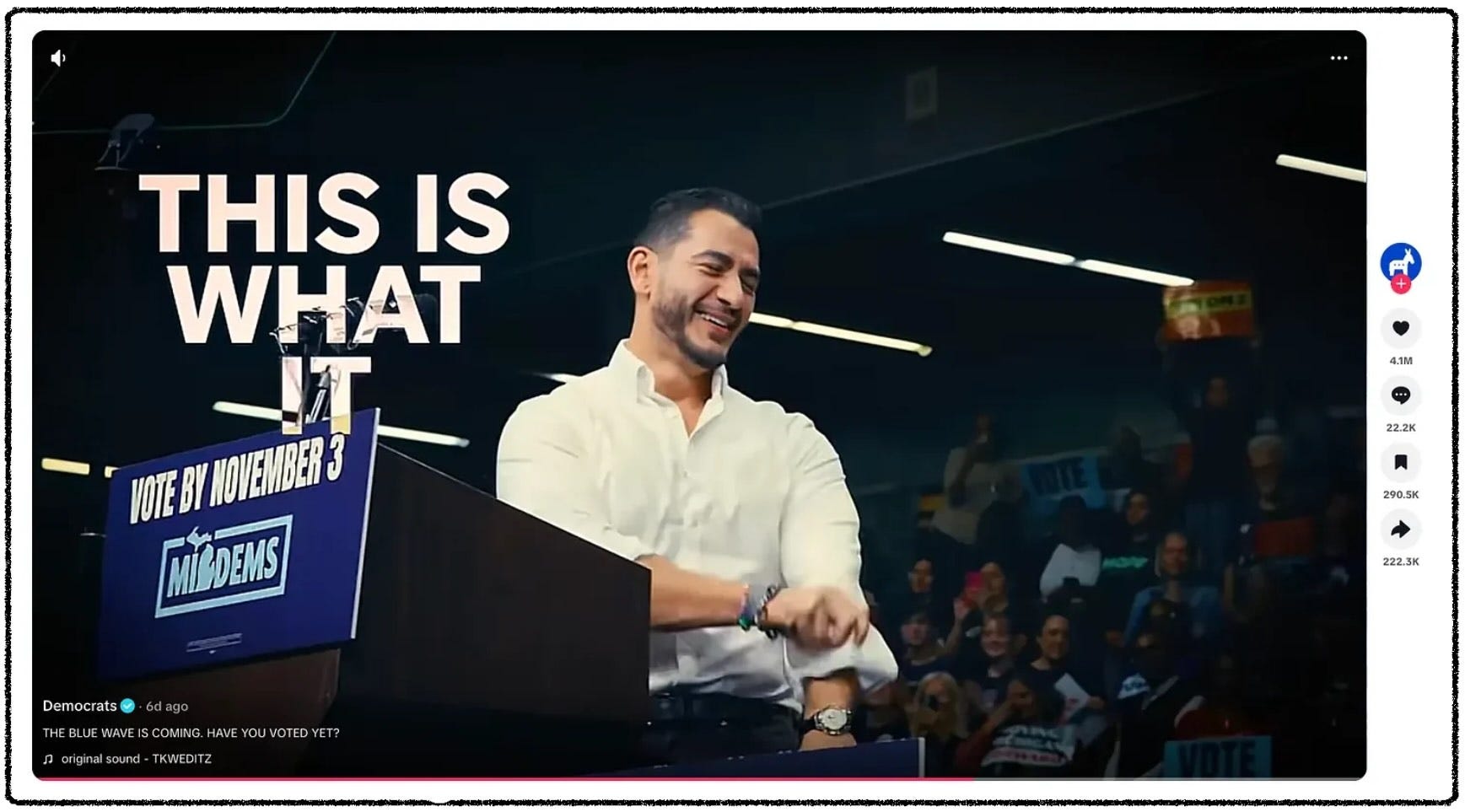
The Democrats were underdogs this cycle, and there’s no shortage of TV shows and movies written about unlikely heroes defeating insurmountable odds. We used pop cultural references as “carriers” to draw more proximity between our viewers and our message—increasing the likelihood they would DM our posts to a friend or add them to their story.
I’ll also add: A number of campaigns this cycle made it extremely easy for us to make edits of their candidates by sharing high-resolution footage or uploading un-captioned videos to X in 4K. Every political campaign should do this! It was a small service, but nabbed them millions more impressions from fan accounts like ours and countless others.
Finally, we built systems meant to last.
I often say the internet is the Democratic Party’s biggest battleground. But while “winning the internet” is a necessary condition to wrest our country from the grips of fascism, the attention-based social media economy can seem inherently at odds with the realities of governance.
If effective governing requires building systems meant to last, I wager that the same can be done for political digital programs. Are you doing all you can to make posting easy and frictionless? Are you optimizing your content for the aggregators and creators who can make your message go further? Are you taking what you have and versioning it out to hit new audiences on different platforms?
Beyond that, systems built to last require resources. While Democratic campaigns across the country did invest more in digital this cycle than I’ve seen in the past, I can’t help but wonder what we as a party might have achieved if more money was put into building out content creation or influencer partnerships teams, and sooner.
I count my team as one of the luckier and more well-resourced ones in the ecosystem, and because of that, we were able to do things like launch FactPost and build up our creator program and have individual staffers specialize in one or two social media platforms. Those investments paid off in millions of impressions our candidates would not have received otherwise.
In any case, know this: In this line of work, the heady, all-hands-on-deck moments powered by an insane headline or an election will inevitably arrive. Have no doubt about that. The hardest and most important work is what happens in the in-between.
Big thank you to Paulina for sharing her playbook and to Ryan Cecil Smith for the wonderful illustrations. If you enjoy free essays like this one, you can upgrade to a paid Link in Bio subscription. You’ll get weekly strategy newsletters and quarterly trend reports, along with access to the Discord community. If you’re already a paid subscriber, thank you for making this newsletter possible!