


Hello! Thank you to the 2,000 of you who attended yesterday’s call with Instagram’s VP of Product Tessa Lyons. Someone commented that it was “the best non-BS seminar” they’ve attended. That’s the goal! The full recording will be available soon for paid subscribers.
The hot topic of the call was long-form video. As I reported on Monday, Instagram is testing the ability to watch longer, horizontal videos within their app. The announcement speaks to a larger trend we’re seeing right now: brands and creators are looking for ways to deepen audience engagement beyond short-form video. We’ve gotten quite good at knowing how far social media content can travel, but do we understand how deeply it resonates?
Today’s newsletter is a guest essay from London-based journalist and consultant Amy Francombe. I’m a big fan of Amy’s reporting in Vogue Business and think her newsletter amy_coded is brilliant. She was also part of the founding team behind the 2019 relaunch of The Face, as well as Deputy Editor of The Basement, a youth-first publication she helped launch. Below she digs into how depth became the new reach.
If you enjoy free newsletters like this one, you can upgrade to a paid Link in Bio subscription. You’ll get weekly strategy newsletters and quarterly trend reports, along with access to the Discord community.
This newsletter is an educational resource and can likely be expensed through your company. I have even written a handy template for you to use when asking!

There’s only so many times you can write about the return to long-form and how the new luxury flex is going offline before you start to wonder if you probably should take your own advice. A recovering chronic passive scroller who could justify the habit under the guise of “reporting”, this year I’ve become much more intentional about where I let my thumb take me.
Maybe it’s because I’ve spent so much time writing about the internet where I’ve watched an endless parade of trends and internet personalities rise and fall that I’ve started to question what attention is actually worth. Today it’s never been easier to rack up a million views, but what’s the point if nobody remembers what you said five minutes later? From headlines declaring the influencer follower count era is dead, or the creeping skepticism around reach and going viral, a recurring theme in my reporting at Vogue Business this year has been questioning what influence today actually means—especially as creators and brands alike start to question whether the numbers they’ve spent years optimizing for even tell us much about the relationships they’re actually building.

“Short form audiences are rented attention, and that rent resets to zero,” adds brand strategist Eugene Healey. Having grown his own platforms to over 600,000 followers combined, he’s well aware that the same things the algorithm rewards (novelty and virality) don’t necessarily give people a reason to remain loyal. “Longer-form is much more valuable for lower-funnel preference and ongoing affinity. It’s much harder to fake as well,” he continues, alluding to his recent video calling out the glut of “knowledge influencers” who are scraping scripts and rehashing them in ChatGPT. “Anyone can make a two-minute script or copy somebody else’s video word for word, or do the same visual hook if you’re a fashion creator or a food creator. But the act of creating long-form, is in itself, a very difficult and onerous task that not many people can do, and very few can do well. I really do think that’s where long-form is powerful, because long-form allows you to build an emotional relationship with an audience that is based on the labor that you put into it.”
After all, how can you really get to know someone in 30 to 60 seconds, even if they’re posting six times a day? When everyone’s an expert these days, long-form is less forgiving, forcing creators to properly show their perspective and build real trust with their audience. But if we’re actually moving from an online world obsessed with breadth to one interested in depth, we need to get better at understanding what that actually looks like.
What makes a valuable long-form audience in 2026?
“What’s the network centrality that happens around them?” Asks my former Condé Nast colleague Nicole Brixi, who is now a senior strategist at Dazed, when I pose the question over a phone call. “Is this creator that has a million followers only hanging out with other creators that are being invited to the same work events and working with the same brands? Because a lot of the time people that do this for a living are incredibly socially awkward and they don’t have real networks. They just have people that they take pictures with and then go home and never speak to them again.”
She sees a similar problem when it comes to relatability. “With big creators nowadays, it’s like, ‘Oh, this is the furthest thing from my reality. I’m never going to be invited to go to the Maldives on a brand trip, and I’m never even going to leave the country.’ Whereas with a small operator, it’s like, ‘Oh, they’ve gone to a restaurant that’s near to where I live, and now that place seems to be really cool and where cool people are hanging out.’ That’s going to bring business to that restaurant, because the people that are following them actually have the means to go and experience those things.
It’s a trap she’s seen brands fall into again and again. “When I was working with brands and working with VVIPs, they would always come back and be like, ‘Well, that was a fucking waste of money, wasn’t it?” She reasoned that, instead, creators with 7K-8K followers might have a 15 percent engagement rate, while someone with a million followers could be getting just 0.3 percent. “It’s a huge audience, but this audience isn’t even looking at the content or engaging with it, so actually, if you broke down the numbers, quantitatively speaking, they’re in the same playing field.”
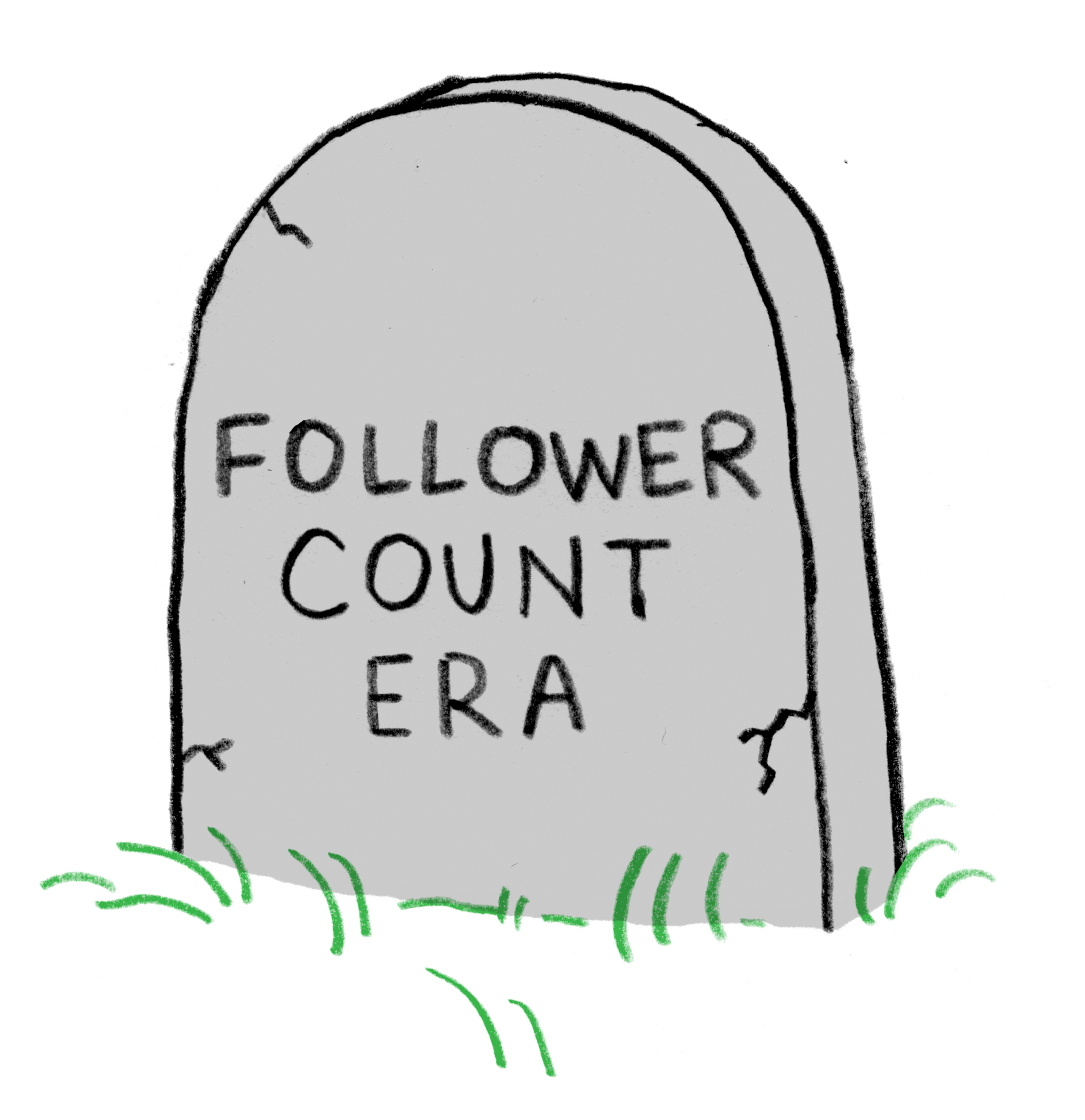
Even then engagement can only tell you so much. “There’s a big shift away from breadth to depth of audience,” says Taylor Kelly, chief strategy officer at Night Media, which manages talent like Kai Cent and Hasan Piker. Taylor points to YouTube’s recent announcement that it was changing how it counts views, so that a view on a video now registers in the first frame. According to analysis from creator marketing platform Agentio, this change will result in public view counts increasing by more than 40 percent for some creators. If the number can change that drastically overnight without any true audience growth, how useful is that metric in the first place?
There’s also something more interesting happening with smaller creators that can’t necessarily be quantified. “Smaller creators or creatives, there seems to be evidence that people who are following them aren’t necessarily following them because of the content, but because of the experience that they give them, which is that you can be part of their friend group,” says Nicole. That sense of proximity—of being able to see yourself in someone else’s world—is difficult to capture in an engagement rate, but it may be closer to what we actually mean when we talk about influence.
There’s another variable that follower counts and engagement rates struggle to capture: time. “The long-form question is less about, ‘Are they the same audiences?’ And more about, ‘Are you getting them at the right time?’ At different points you’ll be interested in consuming shorter-form ideas or shorter-form content. And at different points in time, with different levels of affinity that you might have for a brand or person—you may say, ‘I’m actually ready to dive deeper into the world’,” says Healey.
Taylor points to Twitch as a prime example of what can happen once the relationship gets deeper. “Every Twitch streamer is reading the chat, replying to chat, acknowledging people, you feel seen by the group, right?” He says. “This is more and more the way things are going, where the more things get niched, the smaller the room that you’re in as a viewer, the more chance you have to be an important part of that community. Maybe you’re a mod. Now you can have a relationship with this person who you love and are a fan of.”
The brand impact
Some brands are already putting this into practice. Earlier this year I spoke to Coach CMO Joon Silversein about its Explore Your Story campaign, which was built around long-form storytelling designed specifically for YouTube. The campaign drove more than 15M organic engagements, a 60% increase in global top-of-mind awareness among Gen Z, and a sixfold increase in consideration. Since then I’ve noticed more brands experimenting with formats that give people a reason to stick around for longer than 30 seconds. Figma launched Source Material, a weekly series that invites creative leaders to share their unexpected references and niche inspirations while General Motors has been documenting the race to get Cadillac on the Formula 1 grid in What Makes Fast, a 10-part YouTube docu-series taking viewers behind the scenes of building the sport’s newest team from the ground up.
If we’re really moving beyond follower counts, I’m not sure the answer, though, is to find another number to replace it. An audience is made up of people, and maybe it’s time we got a little better at understanding what’s happening between them.
What I’m scrolling
LinkedIn is testing a bifurcated feed, with “For you” and “Network”. According to Inc., “The ‘Network’ feed shows content from people and pages you already follow or are connected with. ‘For You’ includes posts LinkedIn believes you will find relevant, including content from people completely outside your network.” Thanks to Todd in the Discord for alerting me to this.
Lego appoints its first Head of Celebrity Talent and Brand First Partnerships. According to Variety, Kelsey Gray Sherman will be in the new role and previously comes from the talent agency WME. “Sherman will shape the toy and media company’s approach to celebrity talent, identifying and building relationships with entertainers and brands in ways that go beyond traditional licensing and product collaborations.”
Bottega Veneta is back on Instagram.
Rare Beauty’s campaign reuniting Selena Gomez and Demi Lovato has a whopping 91M views on Instagram. Tyra Booker, Assistant Vice President of Marketing at Rare Beauty, creative directed it. (I interviewed her in 2024 here!) It’s also another clear example of the fun work Good World Creative is making. The creative agency arm of Good World Management, who just so happens to rep both Demi Lovato and Tyra Booker, was the agency behind the spot.
Congratulations to the Milwaukee Brewers on their World Series win. I interviewed their Senior Manager of Digital Content back in May. I think about this quote often: “When people consume our content, I want them to feel like they’re seeing something fresh, not just a take on something they’ve seen from the other accounts and teams they follow. We want to be the model that other teams look at for inspiration, rather than the other way around.”
I’ve been following how Jennifer Lawrence’s new haircare brand mes° is rolling out on social. So far the best piece of content has come from co-founder Jasmina Aganovic.
Firefox’s ad with old internet stars has over 20M organic views. John Solomon, Chief Marketing Officer at Mozilla, told me, “Our goal was simple: reconnect with people who once loved Firefox and give them a reason to come back. I kept thinking about when the internet was fun, weird and interesting. Firefox was part of that era, too. The moment We Believers showed us this idea, we knew it was the one, right away. Who better to invite people back than the people who made us fall in love with the internet in the first place? Seeing how they’ve been able to grab people’s attention, get them thinking about what the internet could still be, and Firefox’s part in that, has been pretty amazing. And given all the work we had been doing on the product over the last 18 months and the overall ick people are feeling about tech right now, we knew it was the perfect moment to drop it.”
Prada worked with legendary Disney animator John Pomeroy for their holiday campaign. The “AI could never”-style reaction to the spot reminds me a lot of the Porsche holiday ad from last year. When you work with talented artists, the process becomes on ramps to the campaign itself. Evidence of effort, baby. Data, But Make It Fashion’s post about the ad has 7.2M views!
Check out the Link in Bio Job Board
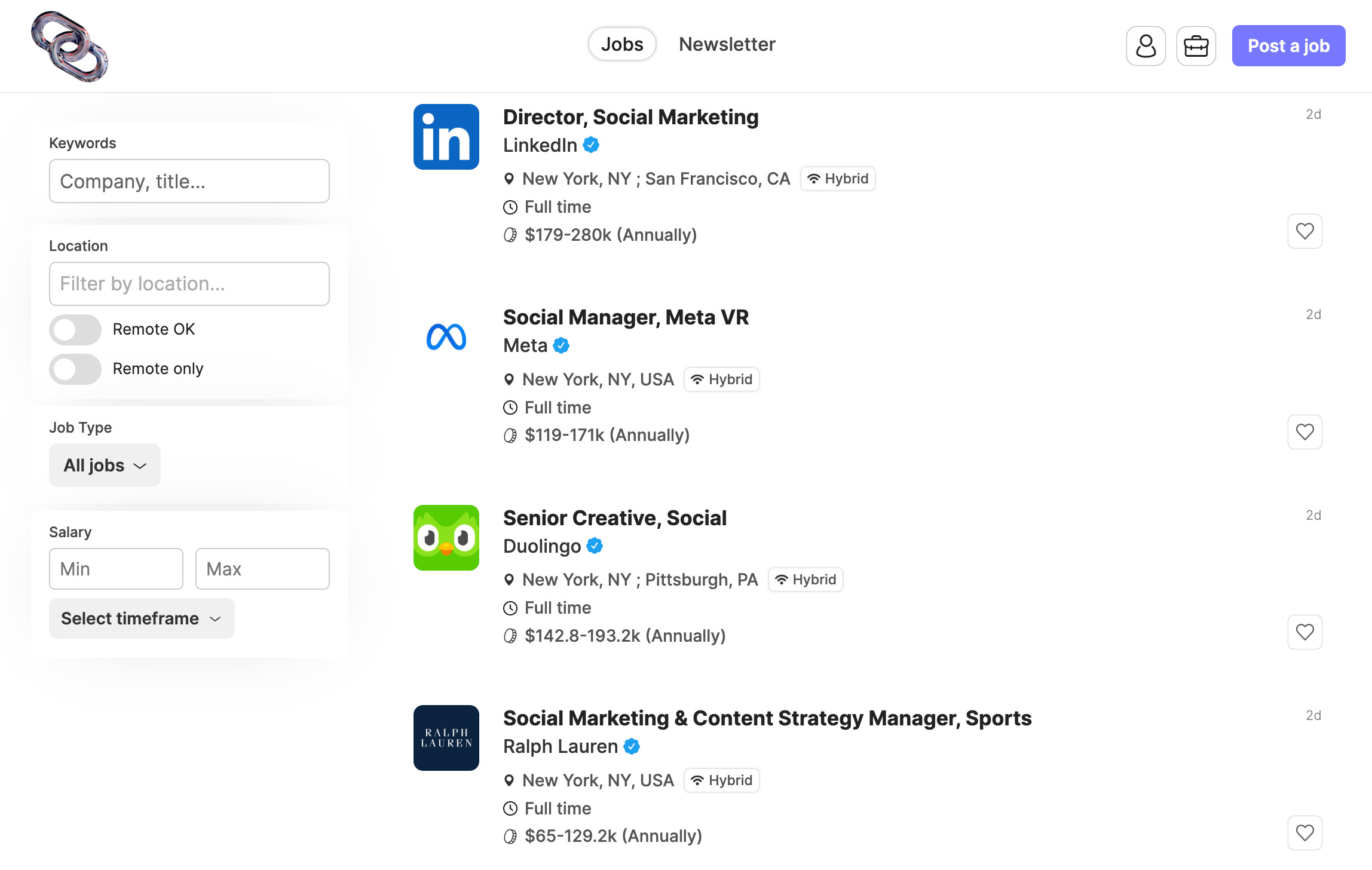
The Link in Bio Job Board features all of the best social media roles in one place, updated daily. Right now there are roles from places like LinkedIn, Duolingo, Ralph Lauren, and more.
If you work for a brand that’s hiring within social media, this job board is for you too. Post your job listings to get in front of talented social media marketers.
Firefox mention in Link In Bio has been on my vision board!! Thanks for the feature 🫶